
Vivian Greven: the body in the age of perfect images
Bodies polished like marble, flawless skin, touching hands, and figures suspended between classical sculpture and digital avatars. Vivian Greven uses painting to explore a contemporary contradiction: we have never seen so many images of the body, but does seeing still mean sensing its presence?
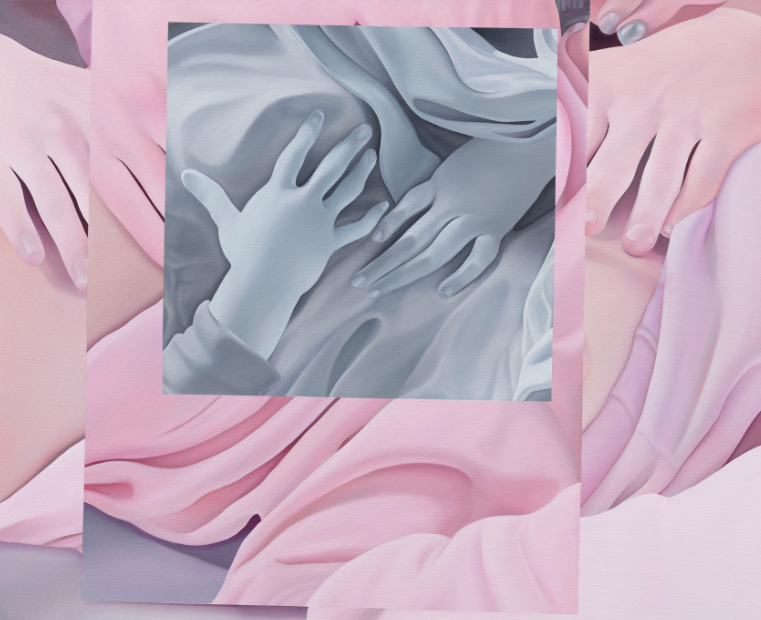
“Colour is not a representation of reality. It’s much more a representation of energy, emotion, and temperature.”
— Vivian Greven, interview with Wallpaper*, 2024.
A body that almost feels real
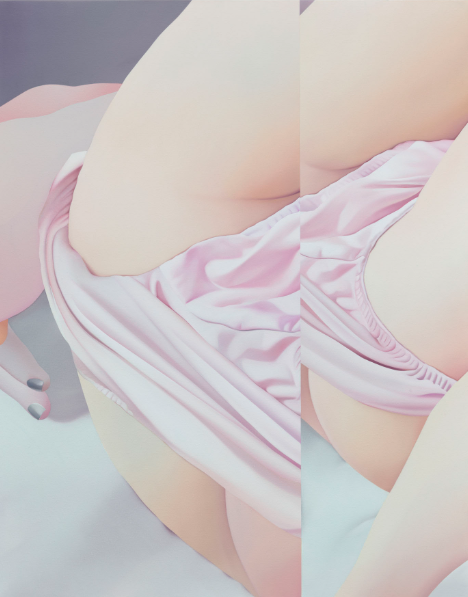
The skin is smooth. Almost too smooth. One hand brushes against another, a face emerges from a luminous surface, and a figure seems to possess the texture of marble while simultaneously resembling an image generated by a screen. In Vivian Greven’s paintings, the body feels close and distant at the same time. Born in Bonn in 1985 and based in Düsseldorf, the artist has developed a language in which classical antiquity, Pop Art, and digital visual culture continually intersect. Her figures may recall a Greco-Roman sculpture, an advertising image, or an avatar. None of these identities ever completely takes over.
From marble to screen
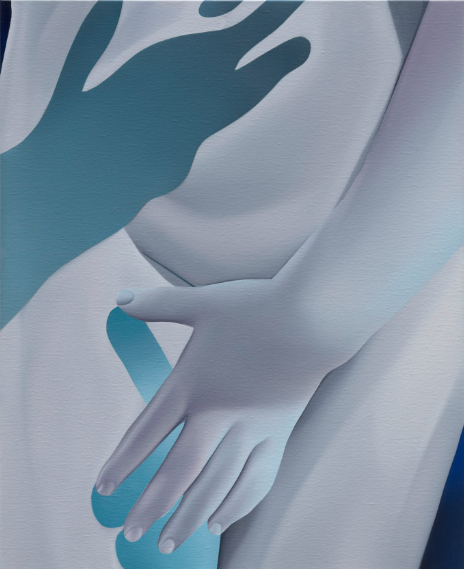
Placing a classical Venus next to Instagram might seem like an enormous leap. In Greven’s paintings, however, the distance narrows. Both produce idealised images of the body. Both turn surface into something to be observed and desired. Kadel Willborn describes her practice as an encounter between antiquity, Pop Art, and digital image worlds within a present in which the internet and social media have destabilised hierarchies between original, reproduction, and simulation.
The difference is not erased. It is placed under tension. The polished surface of an ancient marble can suddenly resemble filtered skin online. A mythological figure can acquire the emotional absence of an avatar. How perfect does a body have to become before it stops feeling alive?
Skin is a threshold
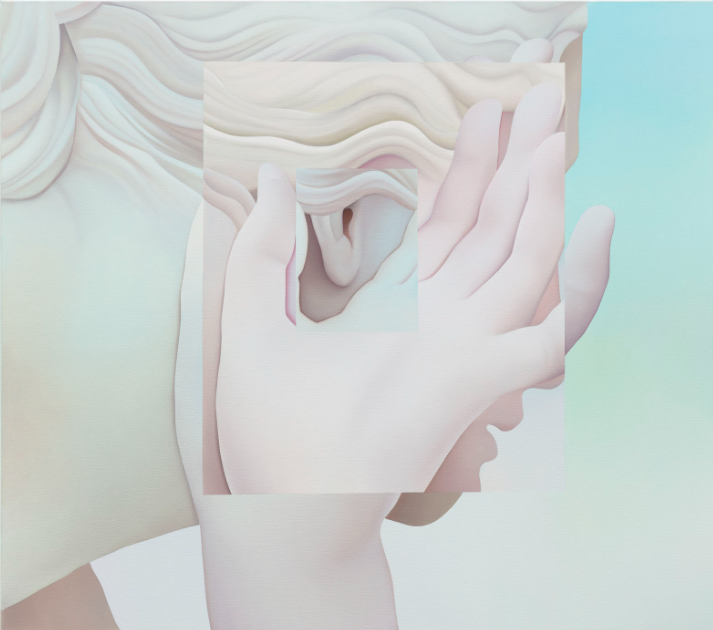
To understand Greven, it helps to look at the surface. The artist has spoken about her longstanding fascination with skin as a membrane: the point where what we see meets the volume and body existing underneath. Technically, the paintings also operate along this boundary. Certain elements physically rise into relief, while others create illusions of depth through almost immaterial gradients. Painting therefore oscillates between object and image, between the physical presence of canvas and the apparently bodiless glow of an LCD window.
Almost a kiss, almost an avatar
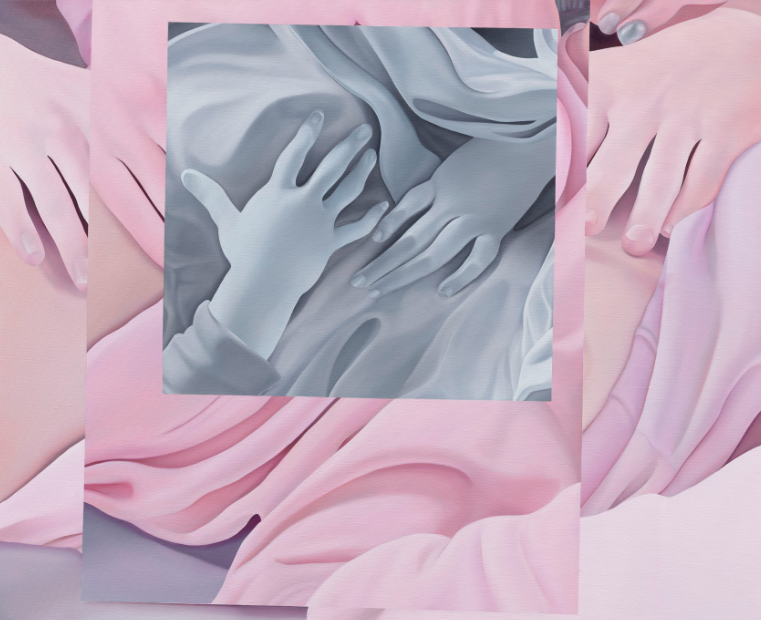
It is precisely within intimacy that this ambiguity becomes clearest. Greven’s figures touch, approach one another, and appear almost ready to kiss. Yet something prevents the scene from becoming completely human. Eyes may lack pupils, skin shows no pores, and bodies seem not to breathe. Discussing When the Sun Hits the Moon, presented by Perrotin in New York in 2024, Greven connected this condition to the contemporary sensation of becoming disconnected from one’s own body: moving through busy days while remaining physically present but unable to fully experience them.
This distinction matters. Digital culture in her paintings is not simply an aesthetic. It becomes a psychological condition. An avatar does not necessarily have to be a virtual character. It can be what we become when we continue to function without being fully present.
Myths never really stayed in the past
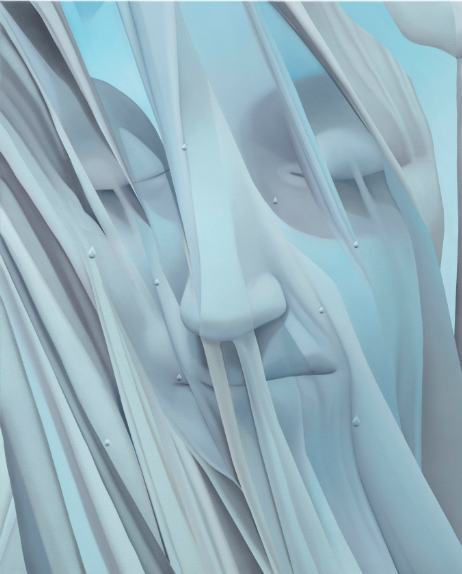
Venus, Cupid and Psyche, Daphne, the Sphinx, Undine. Greven’s painting repeatedly returns to mythological figures and images belonging to Western art history. Yet she does not use them to reconstruct the past. They become structures through which to think about desire, transformation, identity, and relationships. Her 2024 US exhibition revisited, among other references, Venus and Antonio Canova’s celebrated neoclassical sculpture of Cupid and Psyche. In more recent works, Daphne can merge into a tree while the water spirit Undine enters a world shaped by tears, water, and metamorphosis.
In this sense, myth operates almost like an ancient viral image. It travels across centuries, is reproduced, modified, and repeatedly used to tell something new. There is therefore no clear opposition between ancient and contemporary. There is a long history of images that continue to change alongside those who look at them.
In Bloom: to exist is to transform
In 2026, this research entered a new phase with In Bloom, Greven’s first solo exhibition in Korea, opening at Perrotin Seoul on 2 July. Metamorphosis sits at its centre: figures, hands, flowers, and fragments of bodies move through different states without ever settling entirely into one. Daphne becomes plant; human and non-human begin to blur; the flower can simultaneously become an erotic symbol, an object of contemplation, and an image of transformation.
Here, metamorphosis stops being a fantastic event reserved for mythological heroes. It becomes an ordinary condition of existence. The body is born, grows, desires, ages, and changes. Identity, too, never remains completely still. At what precise moment do we stop being what we were and become what we are going to be?
Fast images, slow painting
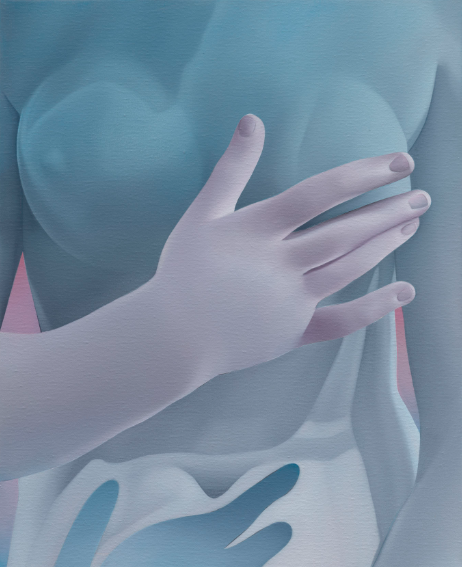
There is another paradox in the way these works are made. Their aesthetic may recall Photoshop, digital rendering, or images scrolling across our phones, yet the process is insistently physical and slow. Greven collects images in a digital archive. When one repeatedly attracts her attention, she prints it and begins constructing physical collages, cutting, reversing, and rearranging forms almost as though she were using software, but with paper and scissors. Only then does she transfer the composition to canvas and build the image through numerous layers of oil paint. Between painting and drying, a single work can take as long as six months.
It is difficult to imagine a process further removed from scrolling. An image may cross our screen in half a second and take months to be reconstructed as a painting. This slowness is not nostalgia for a world before digital technology. It may instead be Greven’s way of forcing a contemporary image to recover weight, materiality, and time.
Seeing is not the same as feeling
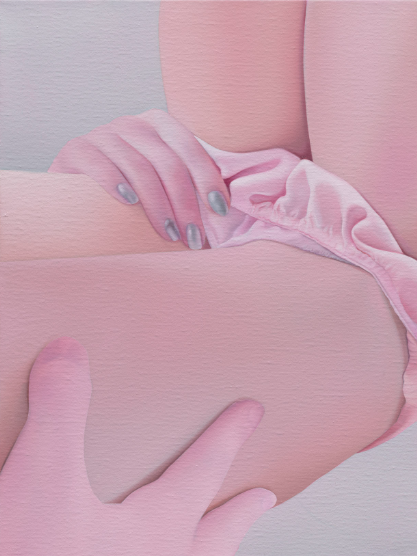
Vivian Greven works within one of the central contradictions of contemporary visual culture. Bodies are everywhere. We enlarge them, modify them, compare them, desire them, and scroll past them every day. Yet the abundance of images does not necessarily make it easier to understand what it means to actually inhabit a body. This is where painting becomes useful again. A canvas has a surface, just like a screen, but it does not disappear when the content changes. It demands presence. It occupies space. It retains the time required to make it. Greven therefore takes some of the most immaterial images of our present and returns them to a physical object. Then she introduces something a screen still struggles to fully reproduce: skin, desire, temperature, proximity, transformation. If we can see a body perfectly without being able to feel its presence, what are we actually looking at? Perhaps this is the most important tension within her painting. Not choosing between marble and pixel, past and present, body and image. But reminding us that between a surface and what exists beneath it, a distance always remains. And it is within that distance that we continue searching for one another.
Keep reading
Helen Beard: desire changes perspective
Saturated colours, tightly framed bodies, and images suspended between figuration and abstraction. Helen Beard uses painting to place female desire at the centre of the image, turning eroticism into a question of perspective, freedom, and representation.
Becky Tucker: what if the future looked like an archaeological artefact?
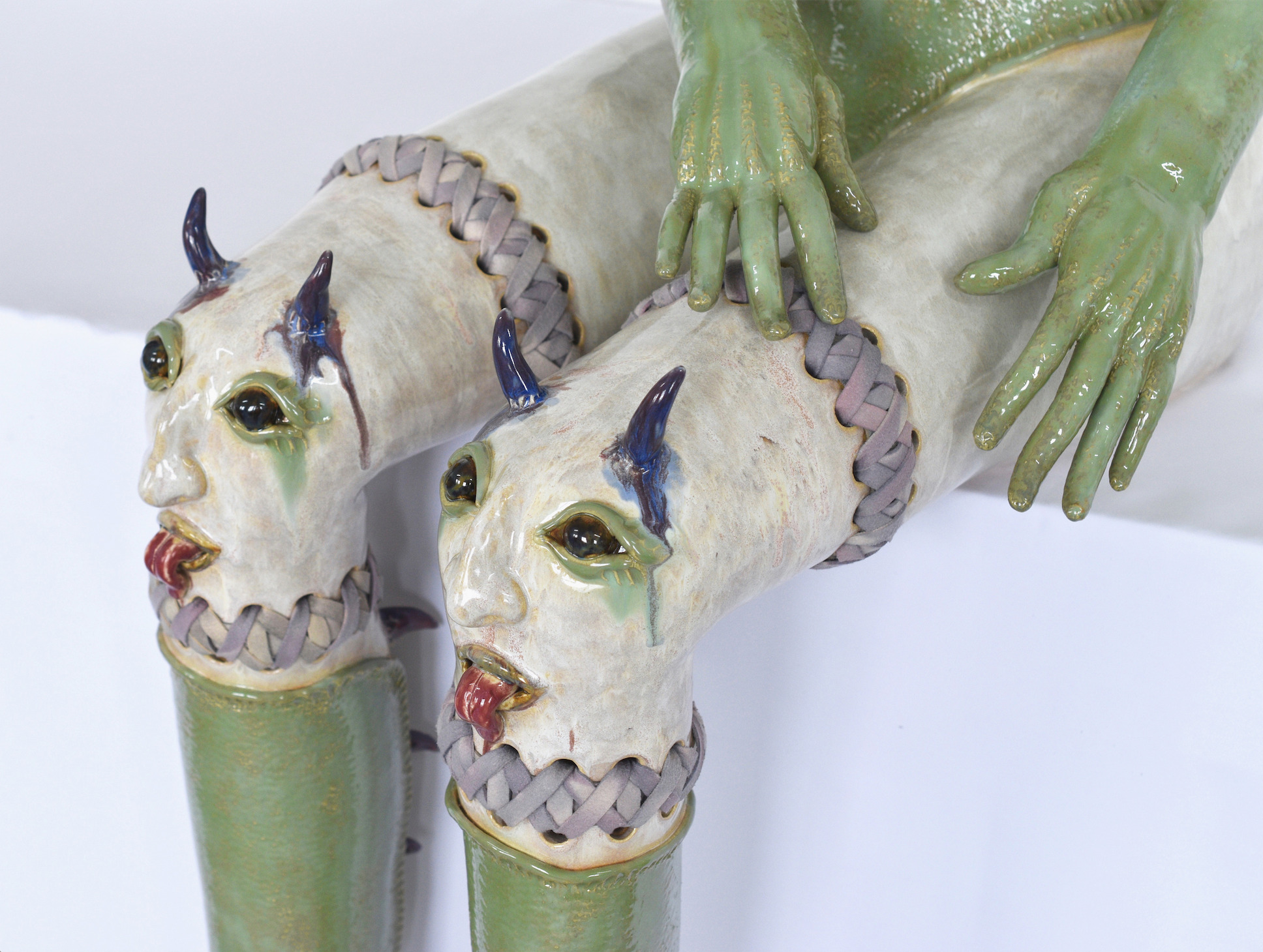
Pale creatures, impossible reptiles, armour, faces emerging from knees and ceramics that could be a hundred or three thousand years old. Becky Tucker creates objects deliberately difficult to place in time, bringing archaeology, mythology, horror and science fiction together. But if someone were to discover the remains of our civilisation one day, how much would they really understand about us?
Ben Crase: what happens when the cowboy no longer has to be tough?
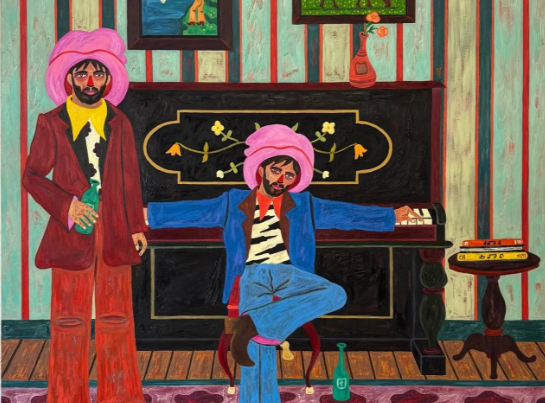
Pink hats, saloons, bears, big cats, chandeliers and men who look like brothers. Ben Crase takes one of the most enduring symbols of the American imagination—the cowboy—and moves him away from conquest, toughness and solitude to explore friendship, vulnerability and belonging. But how much can a myth change when we finally allow its men to be gentle?