
Ben Crase: what happens when the cowboy no longer has to be tough?
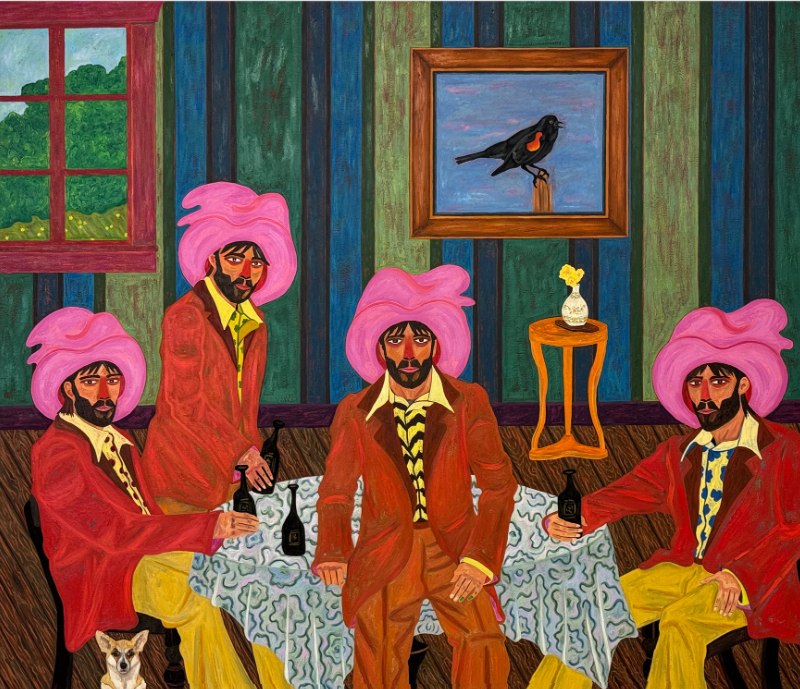
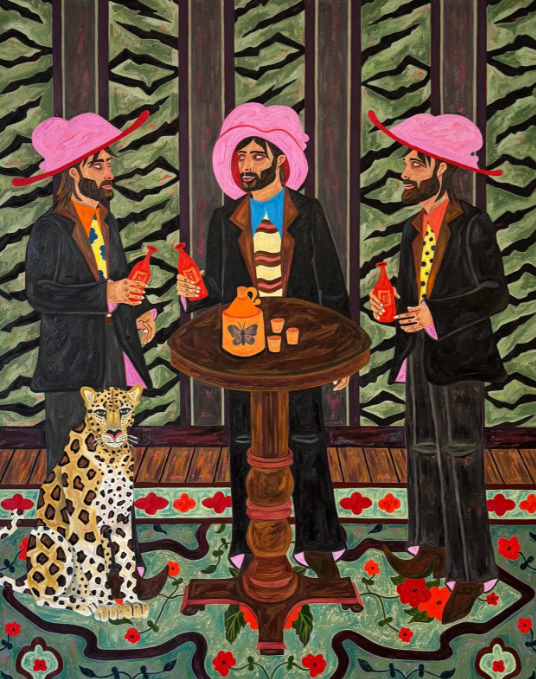
Pink hats, saloons, bears, big cats, chandeliers and men who look like brothers. Ben Crase takes one of the most enduring symbols of the American imagination—the cowboy—and moves him away from conquest, toughness and solitude to explore friendship, vulnerability and belonging. But how much can a myth change when we finally allow its men to be gentle?
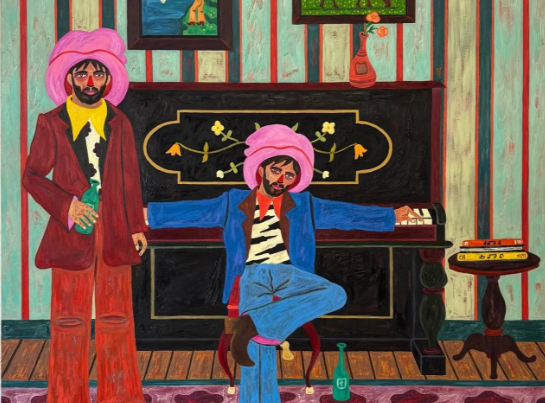
“To me, the pink hats symbolize equality across the board. If we don’t have equality, we’ve got nothing.”
— Ben Crase, on the occasion of SWEETFELLA, Vigo Gallery
The cowboy we learned to know
Few characters have been constructed by the collective imagination as precisely as the American cowboy. He is solitary, resilient, armed, capable of crossing hostile territory without showing fear and usually self-sufficient enough to need no one. Cinema, advertising and popular culture have turned this figure into something far larger than its historical reality: a model of masculinity in which strength and independence often become almost interchangeable. In Ben Crase’s paintings, the West remains immediately recognisable, yet something has changed. Born in Butte, Montana, in 1976 and now based in San Diego, Crase paints men in enormous pink hats inhabiting saloons and impossible interiors, surrounded by decorative patterns, animals and colours that seem to belong more to a dream than to a traditional Western. PIERMARQ, which presents his work internationally, describes these figures as self-portraits within skewed, playful environments, with the recurring pink hats symbolising camaraderie, compassion and kinship. Vigo Gallery more explicitly frames his painting as a revision of frontier masculinity, replacing conquest and bravado with theatricality, tenderness and introspection. Crase does not therefore eliminate the cowboy. He does something more interesting: he preserves enough of the myth for us to recognise it, then gradually removes the obligation for its men to behave as we expect.
His West does not come from the movies
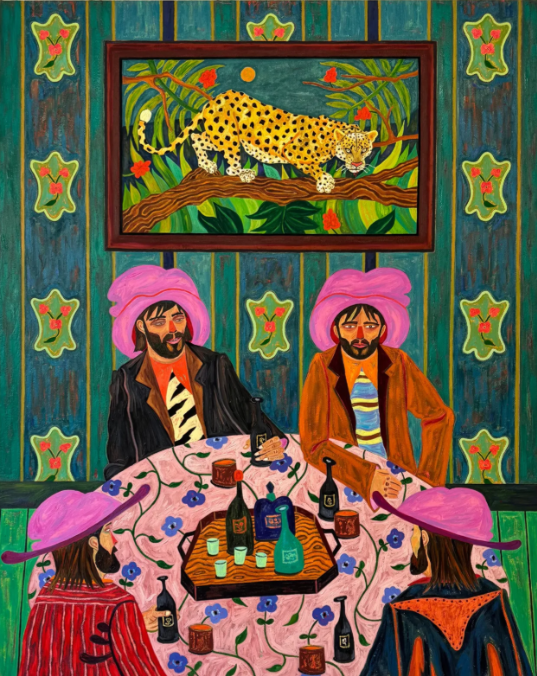
Behind these images lies more than a reflection on American iconography, because Crase’s West begins in a very specific place: Butte, Montana, the mining town where he grew up. For his 2025 London solo exhibition SWEETFELLA, Vigo Gallery reconstructed the artist’s relationship with a city that at the height of its mining boom had more than 165 bars, and where the saloon was not a cinematic set but an ordinary part of social life. Crase remembers entering those spaces as a child with his grandfather, who ran a snack-delivery business serving local bars. This origin profoundly changes the meaning of his scenes. The bars in his paintings do not simply belong to nostalgia for a vanished America; they combine personal memory and invention, family recollection and collective imagery. Smoke On The River, his first American solo exhibition at Anna Zorina Gallery in New York in 2024, similarly emerged from an intimate memory: summers spent floating down the river with his father, who guided the boat with the oars while smoking a cigarette. The great American myth is therefore brought into a much smaller and more personal dimension. Before it becomes frontier, conquest or cinema, Crase’s West is a grandfather, a father, a bar, a river and a series of places that memory inevitably continues to reshape.
Why is everyone wearing a pink hat?
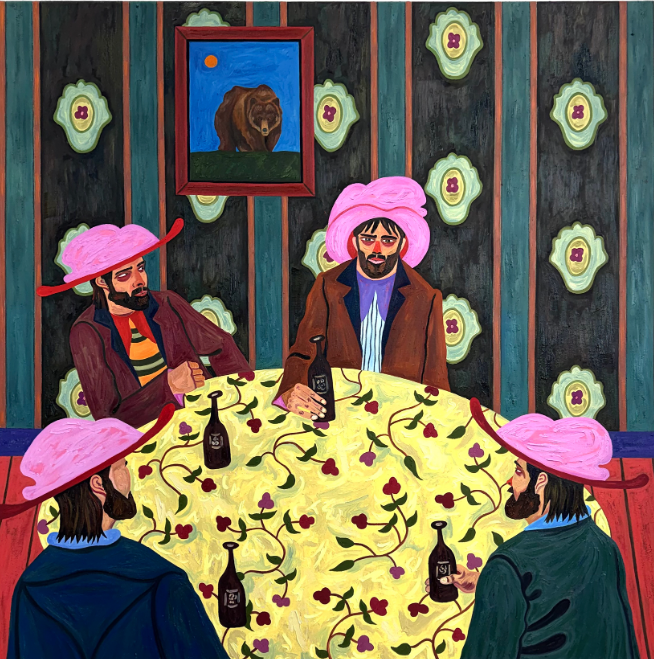
Then there are the hats: enormous, pink and almost impossible to ignore. Within an image built around one of the most traditionally masculine symbols of American culture, Crase deliberately introduces a colour and theatricality that immediately destabilise its code. Yet the hats are more than an aesthetic provocation: for the artist, pink has become a sign of equality, belonging and emotional openness, a kind of paradoxical uniform that places his men within the same community. The resemblance between the figures reinforces this effect. Anna Zorina Gallery notes how Crase’s men often appear like brothers, doubles or reflections of one another; rather than competing for territory, they share the same spaces and eccentricity, turning the traditional image of individualistic virility into one of vulnerability and camaraderie. The shift is only superficially small. If the conventional cowboy proves his strength by showing that he needs no one, Crase’s cowboy seems to become strong precisely through his relationship with others. His men do not necessarily lose their masculinity when they stop performing it as a constant test; instead, they gain the possibility of being ironic, affectionate, tired, elegant, strange and even vulnerable without disappearing from the scene.
What if the saloon were a place to belong?
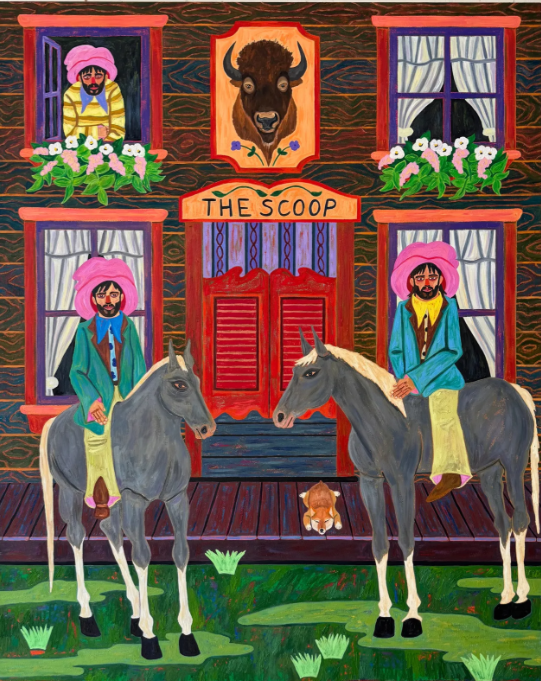
The saloon changes function too. In the traditional Western, it is often a place where power is measured: people enter, drink, provoke one another and tension can quickly become violence. In Crase’s paintings, it retains an element of theatre but becomes above all a space of relationship. His characters gather, share clothes and gestures, and inhabit interiors filled with chandeliers, checkerboard patterns, animals and decoration that seem to turn the bar into a kind of private stage. In SWEETFELLA, Vigo Gallery describes these men as an imagined community of brothers, performers, spirits and different versions of the self; even the animals contribute to the emotional construction of the scenes, with bears and big cats associated with protection and memory, while decorative details emerge directly from the artist’s family history. Zebra and tiger patterns refer to his mother’s taste in interiors, while a piano appears as a tribute to his late father. The result is a West in which belonging gradually replaces conquest. It becomes less important who owns the land, wins the duel or proves himself the strongest man in the room; the more interesting question is who is allowed into the room and whether, once inside, they can feel part of the group.
Can we miss something that never really existed?
Crase is not painting a historical reconstruction of the West, nor does he appear interested in doing so. In SWEETFELLA, he describes beginning this body of work partly as a response to the phrase How the West Was Won, turning it into How the West Was Lost: a way of acknowledging that behind the mythology of conquest lie the destruction of Indigenous cultures, the decimation of buffalo populations and a history that American storytelling has often made cleaner and more heroic than it actually was. His response, however, is not to replace mythology with an illustrated history lesson. Crase deliberately creates a West that never truly existed, populated by men in pink hats who privilege empathy and friendship, protective animals and saloons in which family memory and invention coexist. He describes the paintings themselves as ghost stories belonging to a West that may never have existed but still somehow feels like home. This is where nostalgia becomes particularly interesting. It is not simply the desire to return to something we have lost, but also the possibility of retrospectively imagining what might have been different. Perhaps we can look at the past not only to preserve or condemn it, but to symbolically alter its characters and discover what happens when we allow them behaviours that official history excluded.
Perhaps strength means no longer having to prove it
In recent years, Crase’s imagined world has travelled through very different contexts: from solo exhibitions with PIERMARQ in Sydney and Shining Mountains at Sorry We’re Closed in Brussels to his first American solo exhibition, Smoke On The River, at Anna Zorina Gallery in New York and SWEETFELLA at Vigo Gallery in London during Frieze Week 2025. PIERMARQ has also presented his work at KIAF Seoul, EXPO Chicago, Sydney Contemporary and Untitled Art Miami, giving this mythology rooted so deeply in Montana an increasingly international circulation. Yet the reason these pink-hatted cowboys continue to resonate far beyond Butte may have relatively little to do with America itself. The question they raise is more universal: how much of identity comes from qualities we genuinely experience as our own, and how much from roles we learn to perform because someone has told us that a man, a woman, a father, a leader or a strong person is supposed to behave in a particular way? Crase does not transform the cowboy into a caricature of contemporary masculinity, nor does he seem interested in removing his strength. He simply allows him to possess something the mythology had largely denied him: tenderness, dependence on others, eccentricity, humour and the desire to belong. Perhaps this is where the pink hats become more than a memorable image. The question is no longer whether a man can afford to be vulnerable, but why we spent so long imagining that vulnerability made him less of a man.
Keep reading
Helen Beard: desire changes perspective
Saturated colours, tightly framed bodies, and images suspended between figuration and abstraction. Helen Beard uses painting to place female desire at the centre of the image, turning eroticism into a question of perspective, freedom, and representation.
Becky Tucker: what if the future looked like an archaeological artefact?
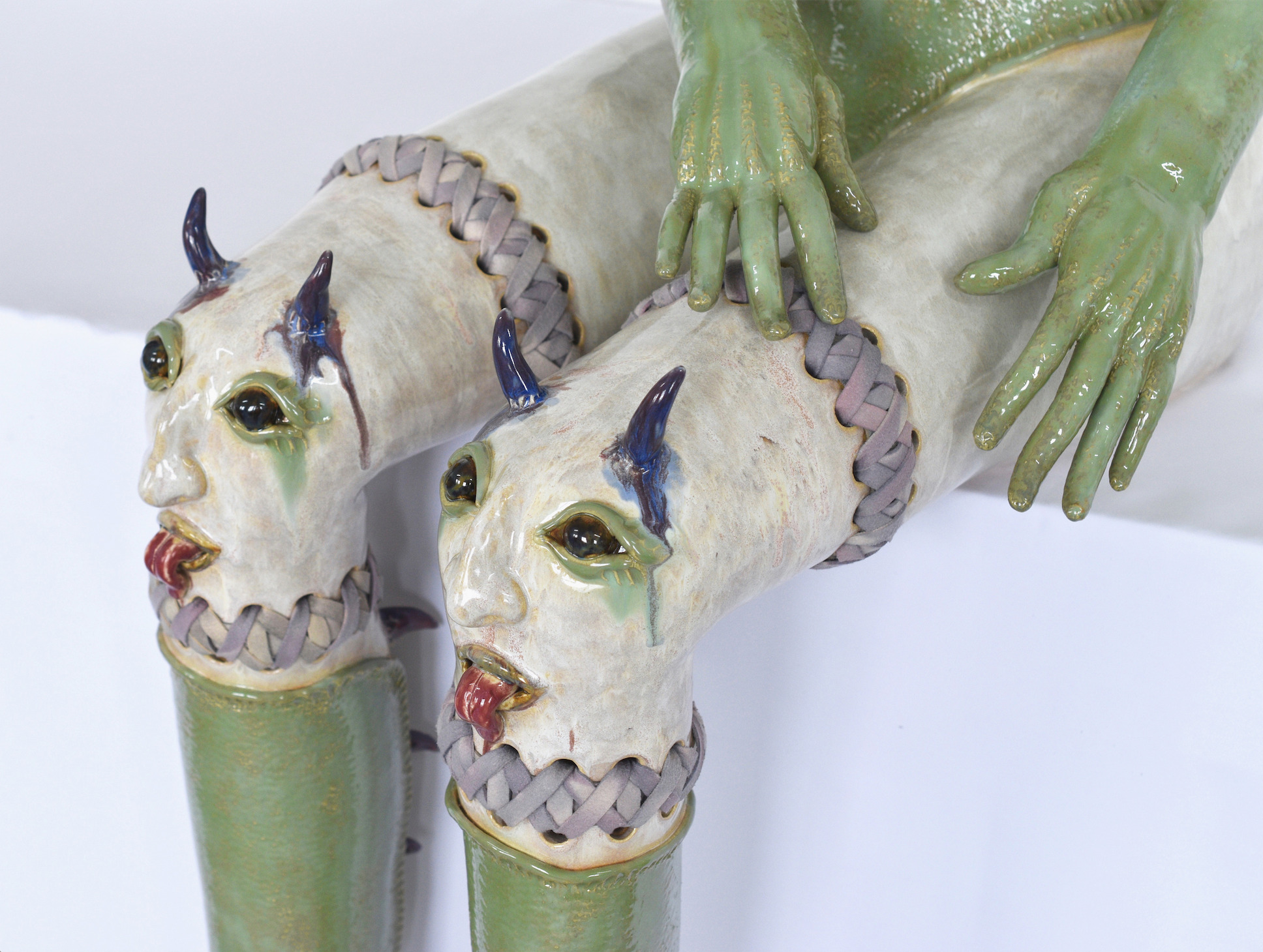
Pale creatures, impossible reptiles, armour, faces emerging from knees and ceramics that could be a hundred or three thousand years old. Becky Tucker creates objects deliberately difficult to place in time, bringing archaeology, mythology, horror and science fiction together. But if someone were to discover the remains of our civilisation one day, how much would they really understand about us?
Bobbi Essers: friendship deserves a large painting
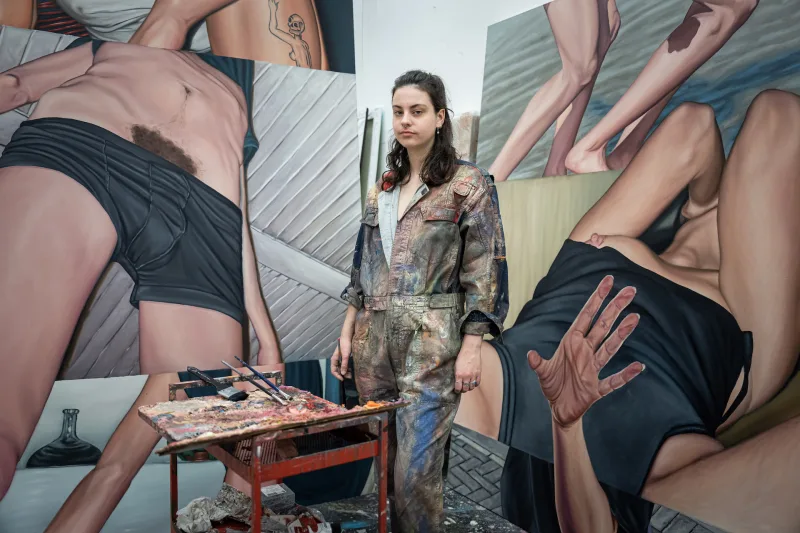
Embraces, hands, clothes, cars, and fragments of nights spent together. Bobbi Essers transforms analogue photographs of her friends into large-scale paintings in which faces often disappear. What remains at the centre is something art has depicted less often than we might think: the way friendship helps construct who we are.