
Becky Tucker: what if the future looked like an archaeological artefact?
Pale creatures, impossible reptiles, armour, faces emerging from knees and ceramics that could be a hundred or three thousand years old. Becky Tucker creates objects deliberately difficult to place in time, bringing archaeology, mythology, horror and science fiction together. But if someone were to discover the remains of our civilisation one day, how much would they really understand about us?
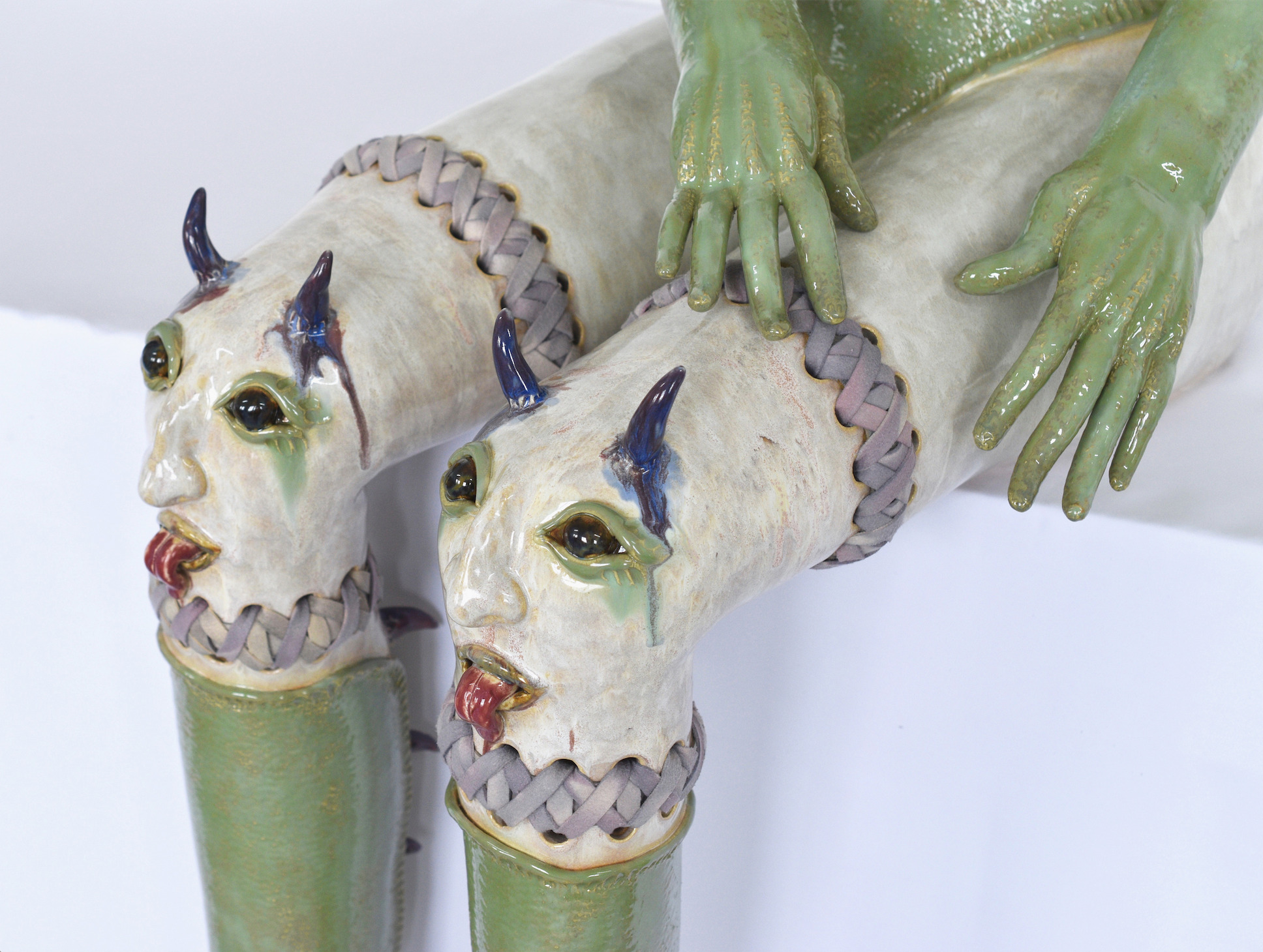
“I feel like a work has been successful if it’s difficult to place.”
— Becky Tucker, interview with Metal Magazine
Objects from a time that does not exist
A humanoid creature has a face embedded in its torso, another seems to emerge near its knee; horns and appendages grow from unlikely places, while imaginary reptiles share the space with figures that might belong equally to a lost civilisation or to a film set thousands of years in the future. This is the world of Becky Tucker, a British artist born in 1993, trained at Edinburgh College of Art and now working in Glasgow, primarily through ceramic sculpture. Tucker deliberately seeks this temporal confusion. Her works draw on ancient artefacts, architecture, armour, costume, cinema and fantastic imagery while refusing to belong entirely to any single source. Speaking to Metal Magazine in 2025, she described anachronism as fundamental to her practice and explained that she considers a work successful when it becomes difficult to place. This ambiguity immediately changes the way we look at sculpture. If we cannot determine whether something belongs to the past or the future, we are forced to ask which clues normally allow us to construct our sense of time.
A snake does not always mean the same thing
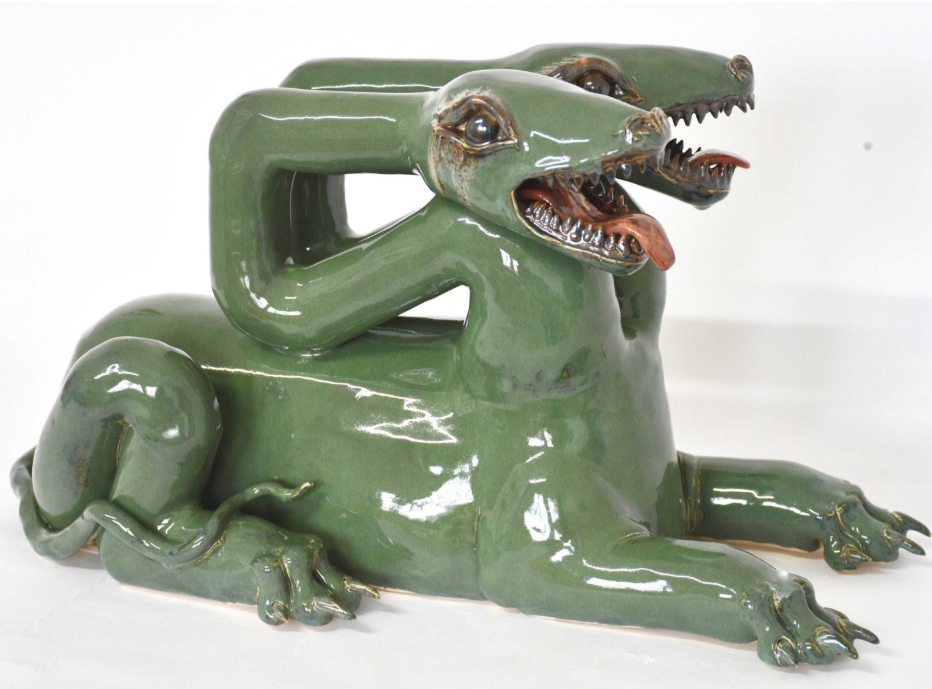
One of Tucker’s central interests is the ability of symbols to change meaning as they travel across cultures and centuries. A serpent can signify fertility, desire, deception, evil, transformation or eternity; the figure survives, while what a community sees within it can change completely. Tucker is drawn precisely to images of this kind, recurring across distant periods without ever becoming permanently attached to a single interpretation. Her creatures therefore become something more than fictional characters. They resemble artefacts from cultures whose codes we have lost and, as with many archaeological objects, we instinctively attempt to assign them a function: deity, guardian, monster, ritual object, armour. Tucker refuses to confirm a single answer, allowing incompatible references to continue coexisting. The same dynamic applies to the present. We constantly produce symbols, images and objects believing their meaning to be obvious, yet history demonstrates how quickly an image can be reinterpreted. Perhaps no symbol belongs to us forever.
They look still, but they may have only just stopped
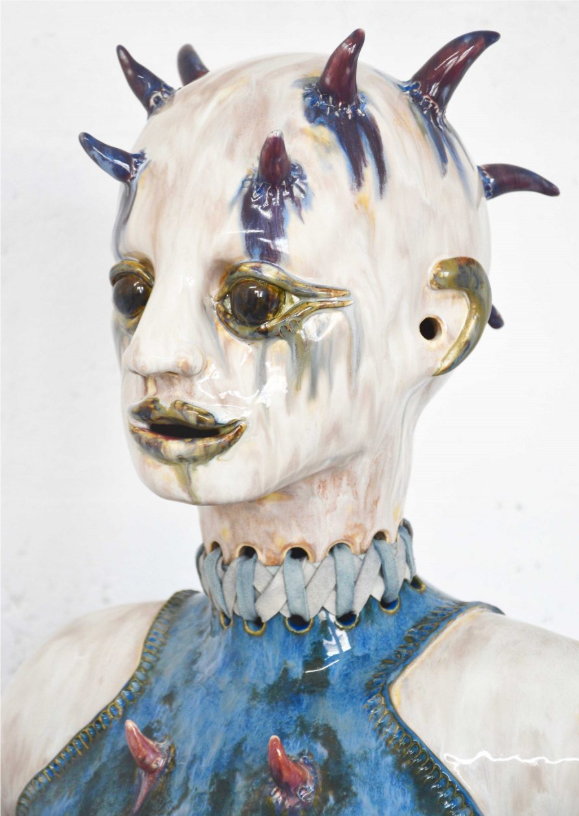
Tucker began working seriously with clay in 2020, after spending much of her training focused on painting and drawing. Small models initially made from wax and polymer clay gradually became more interesting to her than the paintings they had been conceived for, shifting the centre of her practice towards sculpture. Today, she often builds volume directly, allowing forms to change as they develop and accepting the unpredictability of firing and layered glazes as part of the process. Clay is particularly suited to her universe because it can resemble both a body and an artefact at the same time. Tucker connects this quality to fossils: what we are looking at is motionless, yet it still carries the memory of something that may once have been alive. Her sculptures operate precisely on this threshold, suggesting creatures that have been temporarily frozen rather than simply inanimate objects. Perhaps this is why they can produce such a strange sensation. We do not only wonder what they are, but what they might do if they started moving again.
The Quarry: digging through history without knowing what we will find
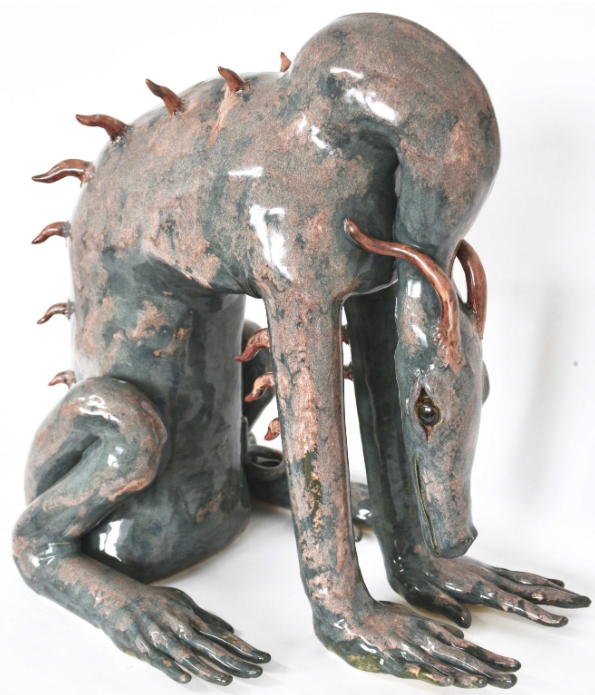
In 2025, this research found a particularly clear expression in The Quarry, Tucker’s solo exhibition at Galerie Fabian Lang in Zurich. The artist created a room populated by imaginary or reinvented creatures; Frieze, which included the exhibition among its recommended shows during Art Basel and Zurich Art Weekend, described entering the space as immediately producing the sensation of being watched. Humanoid figures such as Atlas share the environment with fantastical reptiles, while Tucker’s command of ceramics makes these presences convincing enough to resemble artefacts from a real but unknown world. The title already contains the artist’s method. A quarry is a place from which material is extracted, but the word can also mean something being hunted or pursued. Tucker speaks of both forms of excavation: mining physical material and mining history. For this exhibition, her research also passed through Doggerland, the prehistoric landmass now submerged beneath the North Sea and known through archaeological traces and objects that have resurfaced. Digging, however, does not necessarily produce answers. Sometimes it simply gives us enough fragments to imagine a world we can no longer verify.
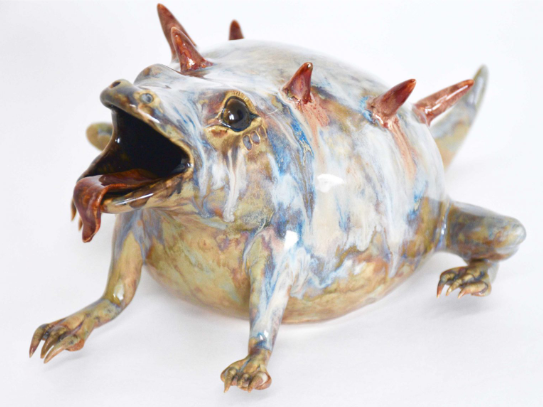
What will they understand about us when only the objects remain?
In recent years, Becky Tucker’s work has moved from the 2023 London solo exhibition Arca to Umbra at Steve Turner in Los Angeles in 2024 and The Quarry in Zurich in 2025; she is now represented by Galerie Fabian Lang, while her practice continues to circulate through international exhibitions and fairs. Yet more interesting than the trajectory itself is what remains constant: Tucker continues to create objects that seem to remember something without allowing us to determine exactly what. This is, after all, what we do whenever we look at a vanished civilisation. We reconstruct beliefs, fears and hierarchies from statues, tombs, armour, decoration and fragments, even though much of their original meaning has disappeared. Tucker’s creatures reverse that experience: rather than presenting authentic relics from the past, she creates the objects of an impossible archaeology in the present. The question therefore stops being only about them. If someone discovered what we leave behind three thousand years from now, what completely mistaken ideas might they construct about who we were? Perhaps every civilisation believes it understands its own present perfectly. Tucker reminds us how quickly a present can become a mystery.
Keep reading
Helen Beard: desire changes perspective
Saturated colours, tightly framed bodies, and images suspended between figuration and abstraction. Helen Beard uses painting to place female desire at the centre of the image, turning eroticism into a question of perspective, freedom, and representation.
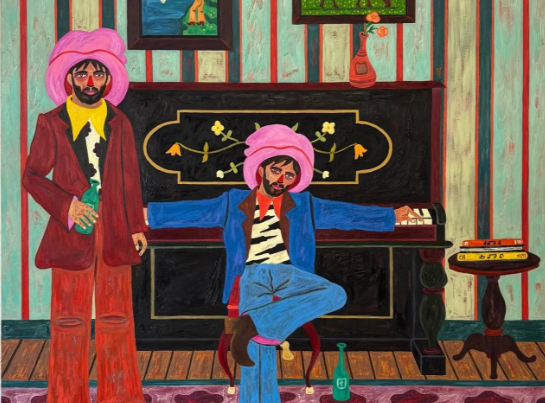
Ben Crase: what happens when the cowboy no longer has to be tough?
Pink hats, saloons, bears, big cats, chandeliers and men who look like brothers. Ben Crase takes one of the most enduring symbols of the American imagination—the cowboy—and moves him away from conquest, toughness and solitude to explore friendship, vulnerability and belonging. But how much can a myth change when we finally allow its men to be gentle?
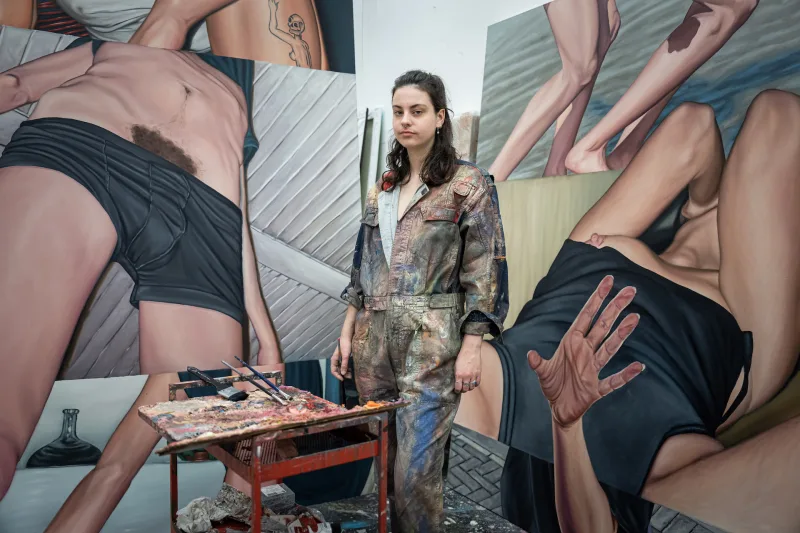
Bobbi Essers: friendship deserves a large painting
Embraces, hands, clothes, cars, and fragments of nights spent together. Bobbi Essers transforms analogue photographs of her friends into large-scale paintings in which faces often disappear. What remains at the centre is something art has depicted less often than we might think: the way friendship helps construct who we are.