
Gori Mora: how close are we when a screen stands between us?
Bodies, mirrors, private rooms, and surfaces that reflect the viewer. Gori Mora uses painting to explore desire, queer identity, and relationships in a world where meeting has become easier, but genuine closeness has not necessarily followed.
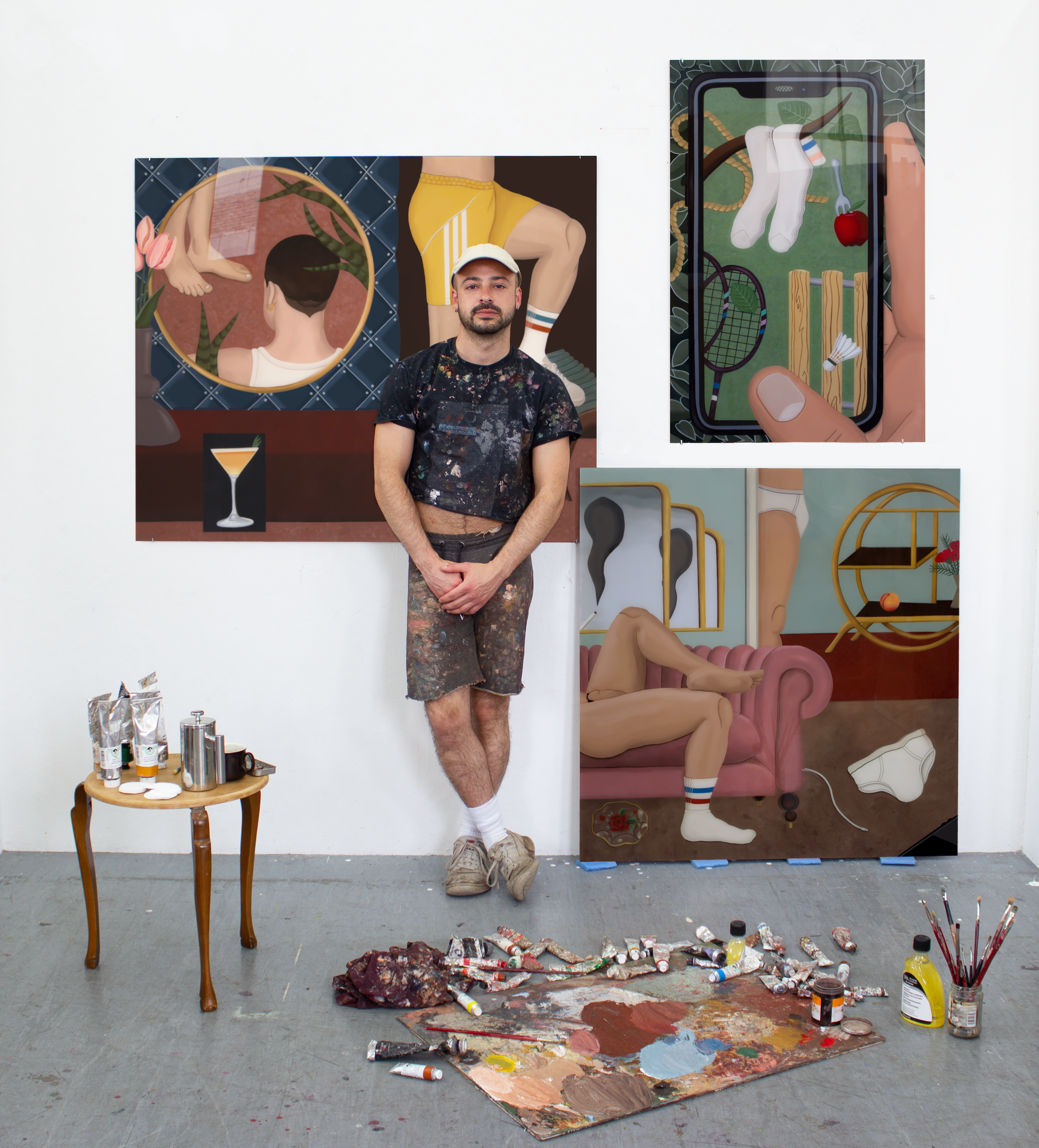
“Our desires also keep changing, and we often feel like we’re always looking for more.”
— Gori Mora, interview with AOAP Projects, 2025.
It almost looks like a screen
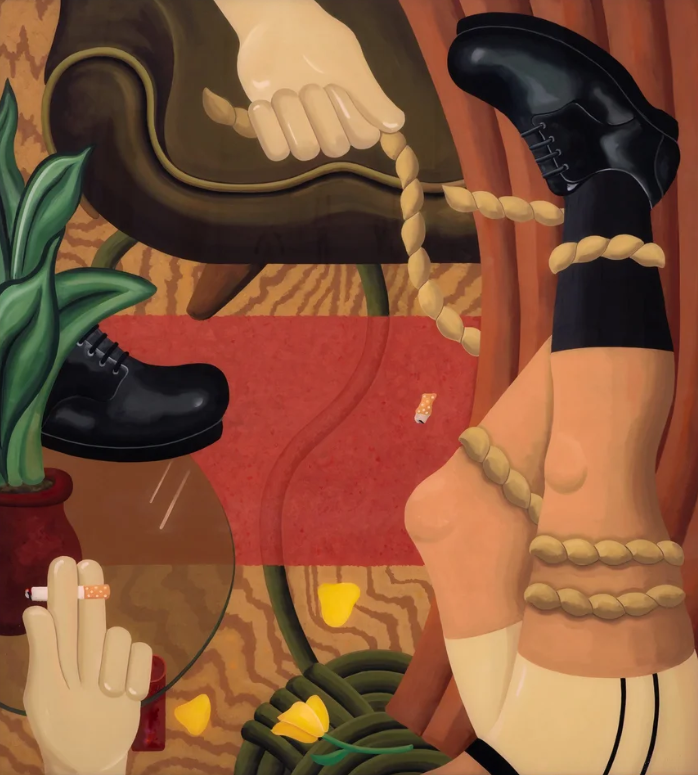
A bare leg. A tap. A plant. A face reflected in a mirror. In Gori Mora’s paintings, we are rarely allowed to see everything. Interiors are fragmented, bodies enter and leave the frame, and we often have the sense of looking into one room through another. Born in Mallorca in 1992 and based in Glasgow, Mora constructs intimate images without granting the viewer complete access. It is a deliberate contradiction: we can see, but we cannot necessarily enter. As early as 2022, when Layering Intimacy opened at Galería Pelaires, Artnet identified a direct connection between these fragmented scenes, Mora’s recurring mirrors, and the way identities are constructed and observed through social media.
The surface is part of the story
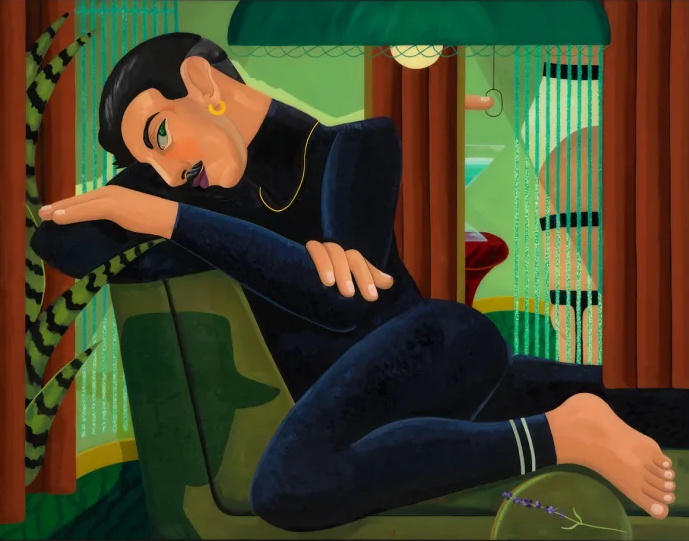
The way Mora paints is inseparable from what he wants to explore. In works more directly concerned with digital experience, he uses oil on Perspex, but does not paint on the surface we eventually see. He works on the reverse of the sheet, beginning with details and moving towards the background; only when the painting is complete does he turn the panel around. The viewer therefore encounters the image through an immaculate acrylic surface. The painting is physically there, yet remains on the other side.
The contrast is precise: one of art history’s most traditional materials, oil paint, is viewed through an industrial material that recalls the luminosity and distance of a screen. The Perspex can also catch the viewer’s reflection. We do not simply look at the represented body; we see ourselves overlapping with it.
Desire in the age of abundance
Technology itself is therefore not the real subject. What matters is what technology does to desire. Dating apps and social media have multiplied the possibilities of meeting people, observing other bodies, and imagining alternative lives. Mora points to the paradox within this abundance: when possibilities appear endless, it can become harder to feel satisfied with what we already have. Desire does not necessarily find a destination; it can become a continuous search for the next possibility.
When every person can be compared with endless alternatives, can we still understand what we actually desire? This is where Mora’s fragmented interiors become more than erotic scenes. They describe a psychological condition: continually approaching the possibility of something without necessarily being able to reach it.
From desire to community
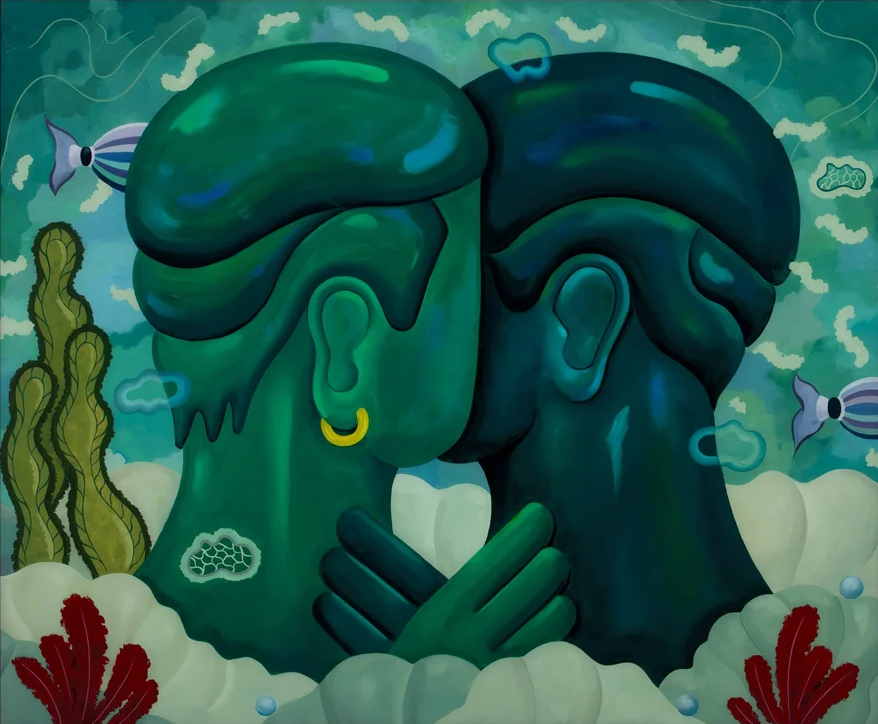
Mora’s practice, however, does not remain fixed on a critique of digital life. With Being in Touch, presented at Galería Pelaires between 2023 and 2024, the focus shifted towards what might resist distance: friendship, physical contact, care, and belonging. The paintings evoke a suspended summer populated by romantic relationships, friendships, and bodies touching one another. Mora describes these images as moments temporarily removed from the chaos outside.
Heads resembling multiplying cells also begin to appear. Their repetition is not simply about identity. It becomes an image of interdependence: caring for oneself cannot be entirely separated from caring for others. Galería Pelaires situates Mora’s lived experience as a queer artist within a broader network of mutual connections, where bodies, love, and authenticity also acquire a political dimension.
Building places where the guard can come down
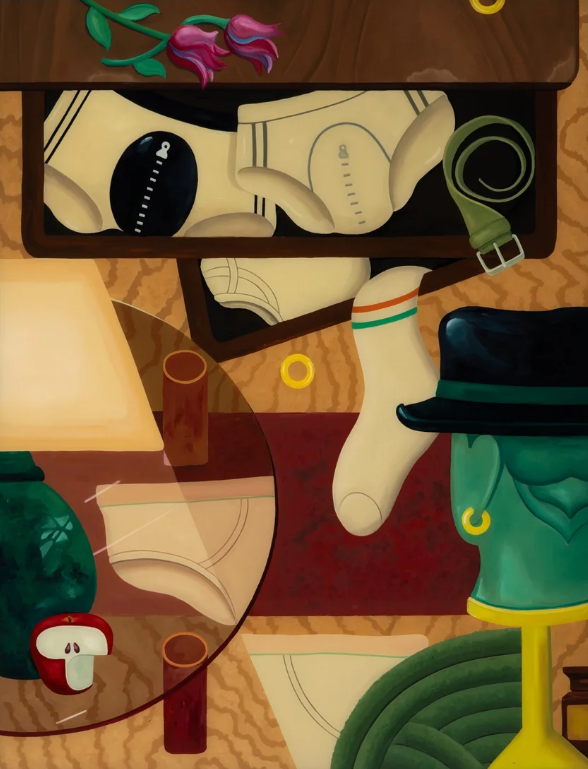
In 2024, Burning Desires, Mora’s solo exhibition at Unit London, moved this research towards queer safe spaces and their capacity to transform the people who inhabit them. Desire is no longer treated only as an individual impulse. It also becomes what allows people to recognise one another, find other bodies, and construct spaces in which certain identities can exist without constantly having to explain or defend themselves.
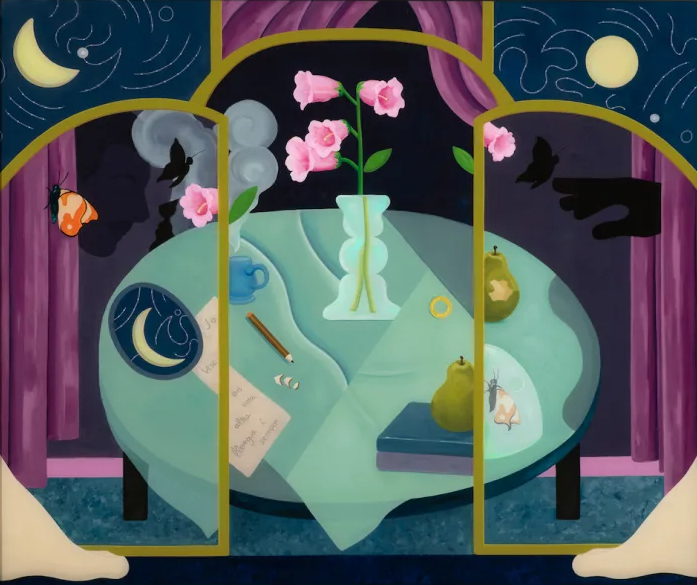
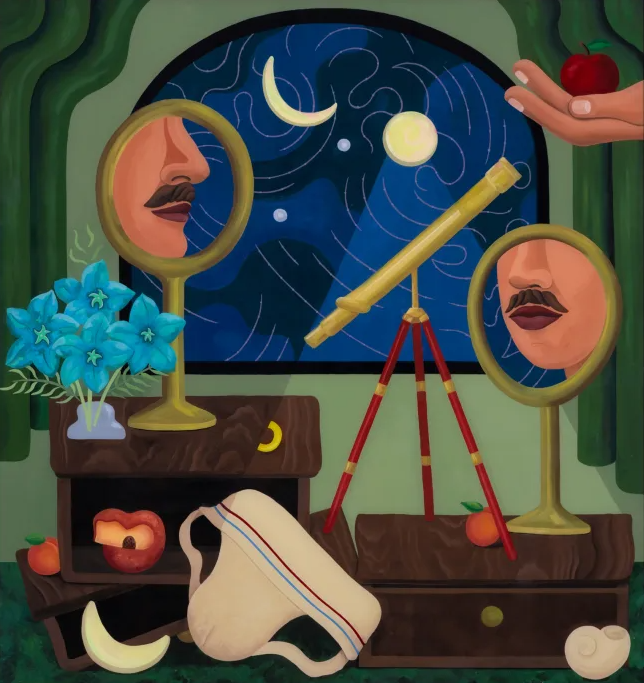
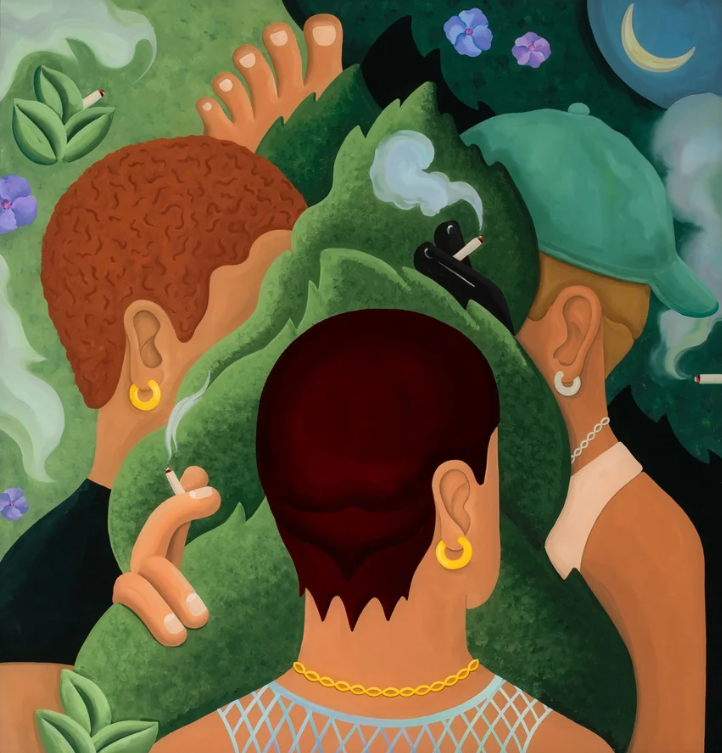
Works such as Baddies, Union, Inferno Boulevard, and Night with constellations expand this visual vocabulary: overlapping bodies, cigarettes, moons, plants, masks, mirrors, and domestic objects create nocturnal worlds where intimacy and theatricality coexist. They are imaginary spaces, but they emerge from a concrete need: to feel safe enough to desire freely. The works were presented around Mora’s 2024 London solo exhibition.
The personal becomes history
Defining Mora’s work only through desire would nevertheless miss an important part of the practice. He uses his own queer experience to interrogate a collective history as well: models of relationships, representations of bodies, eroticism, and forms of belonging that existed before him and continue to shape the present. Galería Pelaires explicitly emphasises this relationship between individual experience and queer history.
This became particularly visible when his work entered Sida. Una historia silenciada en el contexto balear, curated by Jesús Alcaide at Es Baluard Museu in 2024 and centred on the history of HIV/AIDS in the Balearic context. Placing a contemporary practice concerned with desire and community within this framework reminds us that intimacy never begins in neutral territory: it carries what previous generations were able to live, hide, lose, or secure.
From Mallorca to Glasgow, and back again
Geography is part of this story too. Mora grew up in Mallorca, moved to Barcelona in 2011 to study Fine Art, and relocated to Glasgow in 2017, completing his postgraduate studies at the Glasgow School of Art in 2018, where he continues to live and work. After graduating, he received the Royal Scottish Academy’s John Kinross Scholarship for a period of research in Florence. My Florence Souvenir is now part of the Royal Scottish Academy collection, while Stormy Day entered the collection of X Museum in China.
In 2026, that trajectory returned to Glasgow with Signals & Echoes, a two-person exhibition with James Rigler at Kendall Koppe during Glasgow International. It marked both artists’ first presentation with the gallery. The recent works continue to move around desire, proximity, and queer identity, but Mora’s wider trajectory now extends beyond the relationship between painting and social media alone.
Being connected is not the same as being close
Perhaps this is the tension holding Gori Mora’s practice together. Technology promises access. Desire promises proximity. Communities promise belonging. Yet none of these conditions entirely eliminates the distance between one person and another. Perspex makes that distance visible. The image is there, only millimetres away, yet a surface prevents us from reaching it. We can move as close as possible and still encounter our own reflection. In recent years, however, Mora’s paintings seem to search for something beyond that surface: touch, friendship, care, safe spaces, and shared memory. Not the fantasy of eliminating all distance, but the possibility of building relationships strong enough to cross it.
If the same surface that allows us to meet is also the one keeping us apart, where does intimacy actually begin? Mora’s paintings may not be looking for an answer. Instead, they remind us that being visible does not necessarily mean being known, being desired does not mean being loved, and having access to others does not yet mean being with them.
Keep reading
Helen Beard: desire changes perspective
Saturated colours, tightly framed bodies, and images suspended between figuration and abstraction. Helen Beard uses painting to place female desire at the centre of the image, turning eroticism into a question of perspective, freedom, and representation.
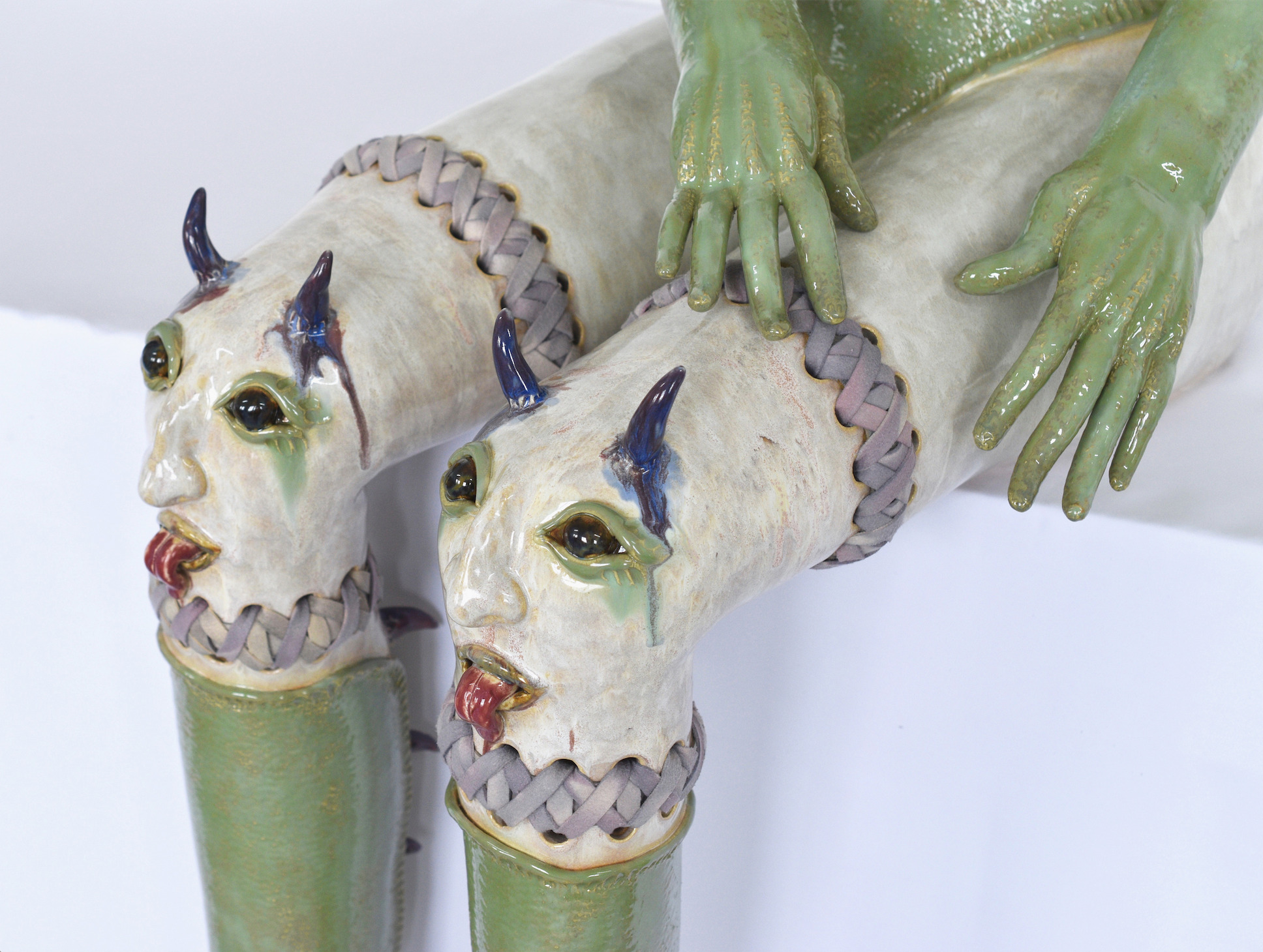
Becky Tucker: what if the future looked like an archaeological artefact?
Pale creatures, impossible reptiles, armour, faces emerging from knees and ceramics that could be a hundred or three thousand years old. Becky Tucker creates objects deliberately difficult to place in time, bringing archaeology, mythology, horror and science fiction together. But if someone were to discover the remains of our civilisation one day, how much would they really understand about us?
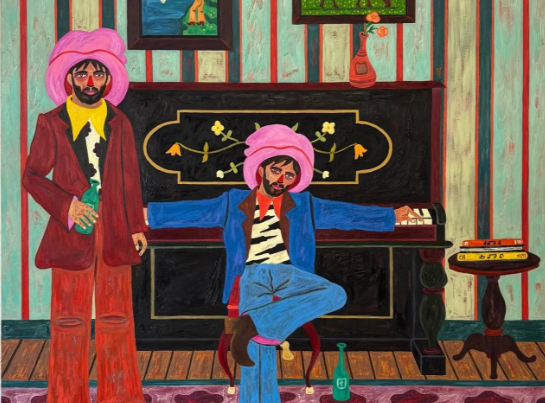
Ben Crase: what happens when the cowboy no longer has to be tough?
Pink hats, saloons, bears, big cats, chandeliers and men who look like brothers. Ben Crase takes one of the most enduring symbols of the American imagination—the cowboy—and moves him away from conquest, toughness and solitude to explore friendship, vulnerability and belonging. But how much can a myth change when we finally allow its men to be gentle?