
Ding Shilun: painting the present as a personal mythology
Manga, Chinese folklore, Goya, fashion, cinema, and pop culture coexist in Ding Shilun’s large-scale paintings. Born in Guangzhou and working between China and London, the artist transforms the confusion of contemporary life into personal fables suspended between seduction and unease.
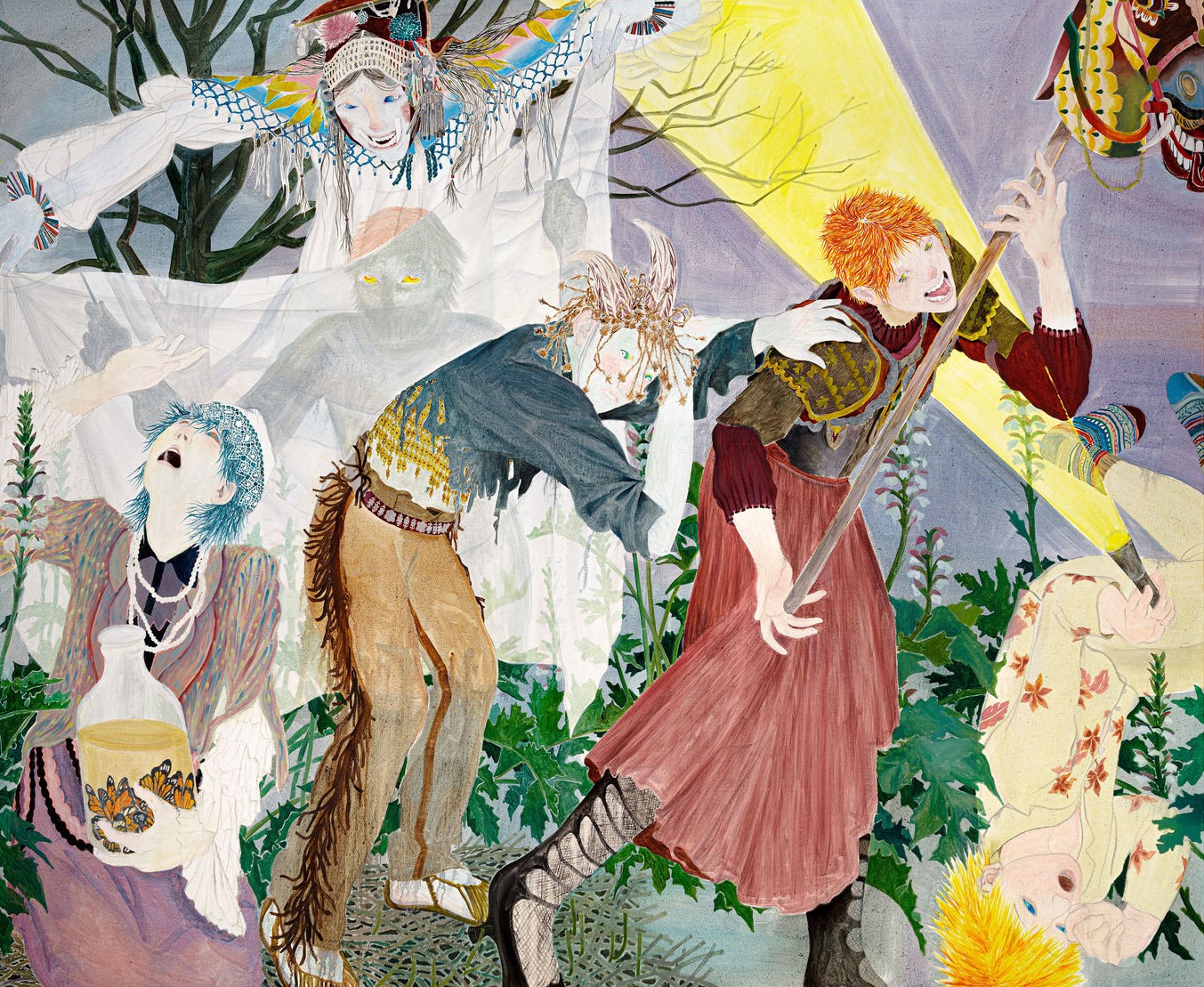
“I’d describe my practice as a sugar-coated bullet.”
— Ding Shilun, interviewed by Alex Needham for W Magazine, 2024
Entering a painting like entering a dream
At first glance, Ding Shilun’s paintings are seductive. Pale colours, elegant figures, vegetation, costumes, animals, and almost translucent surfaces create worlds in which the eye could wander indefinitely. Then something changes. A skull appears, a body takes on an impossible pose, or a cartoon character encounters a mythological creature. The scene is no longer reassuring. Born in Guangzhou in 1998 and working between London and China, Shilun uses precisely this tension to explore the absurdity of everyday life, mixing personal experience, art history, and visual cultures that might otherwise seem far apart.
A visual culture without borders
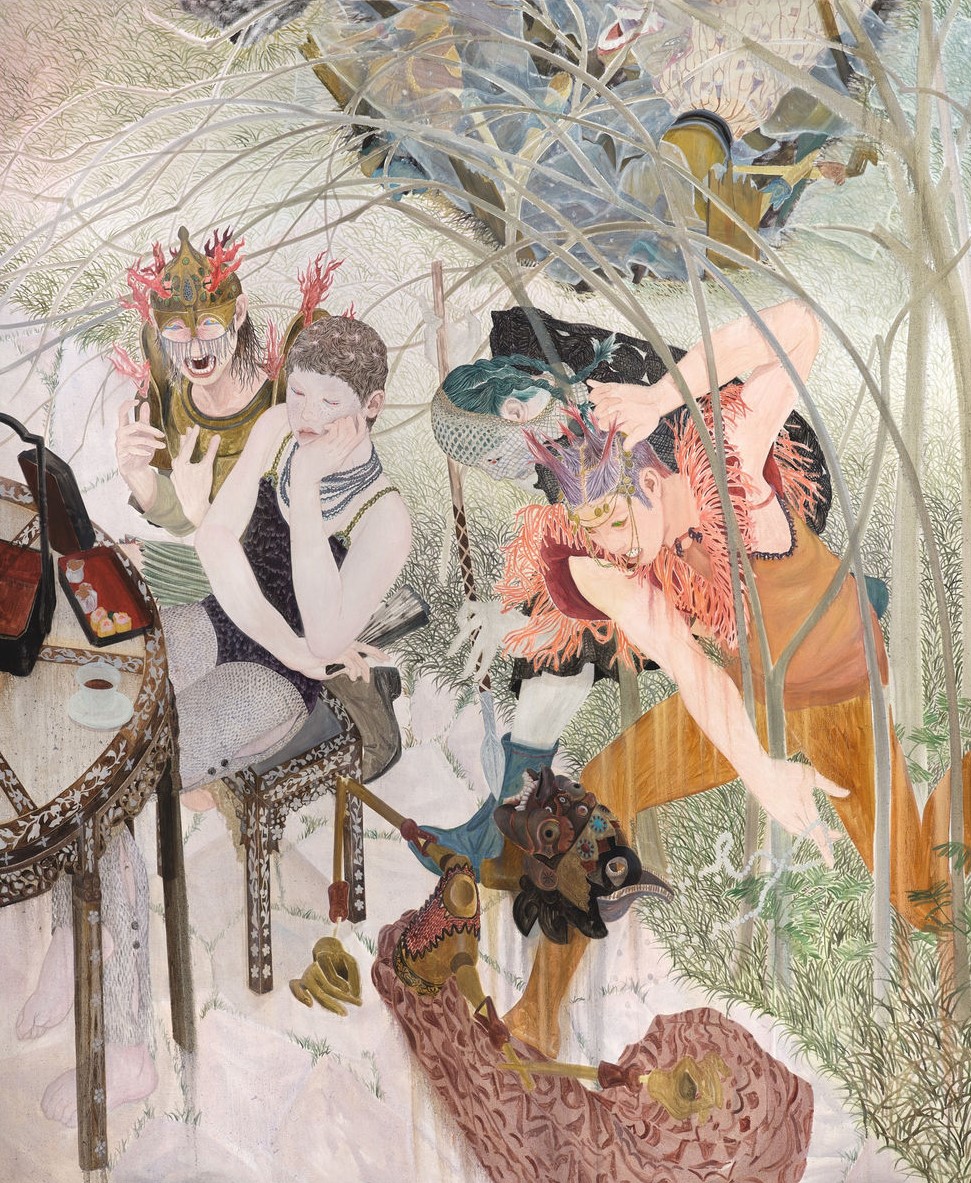
Francisco Goya and Japanese animation, ancient Chinese legends and Disney, Gustav Klimt, fashion, advertising, and cinema can all coexist within Shilun’s paintings. In Spectres in Rehearsal, presented by Bernheim in Zurich in 2026, Cinderella, the Cookie Monster, and anime references entered compositions structured around the tradition of grand history painting. This is not quotation for its own sake. Shilun belongs to a generation raised within a global archive of images, where high culture, memes, films, religion, and personal memories can occupy the same plane. His paintings make this condition visible.
Personal fables for emotions that resist explanation
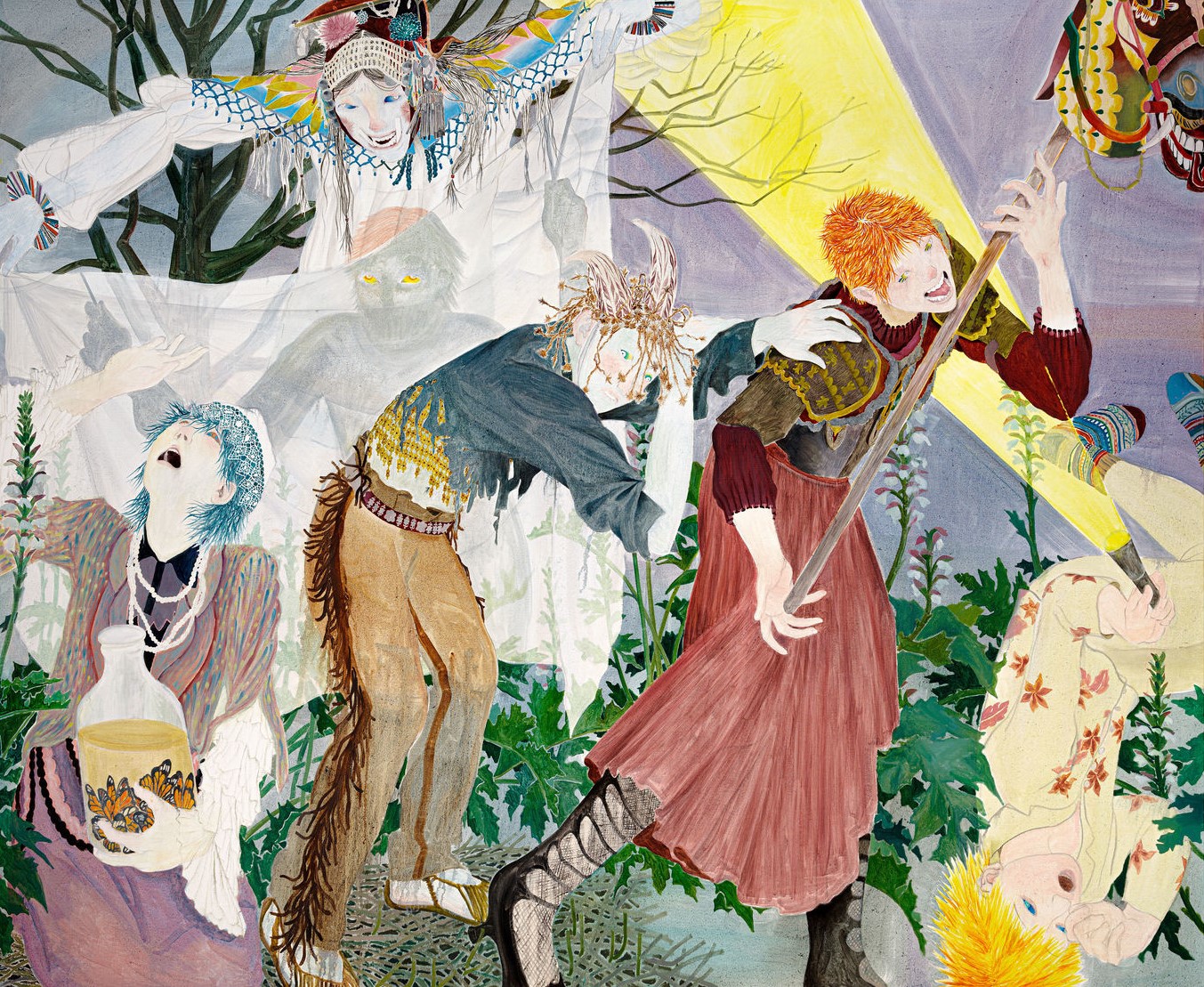
Shilun describes his narratives as “personal fables.” Their protagonists are not characters to be decoded through a precise storyline, but projections of different parts of himself. Living between cultures and systems of reference therefore enters directly into the paintings. Speaking to W Magazine, the artist described the figures in his works as embodiments of his own experience, while at ICA Miami he framed them as projections shaped in part by the confusion of living across different ideologies. Mythology thus becomes a tool for transforming difficult-to-define emotions into images that can be shared.
Sweetness always hides something
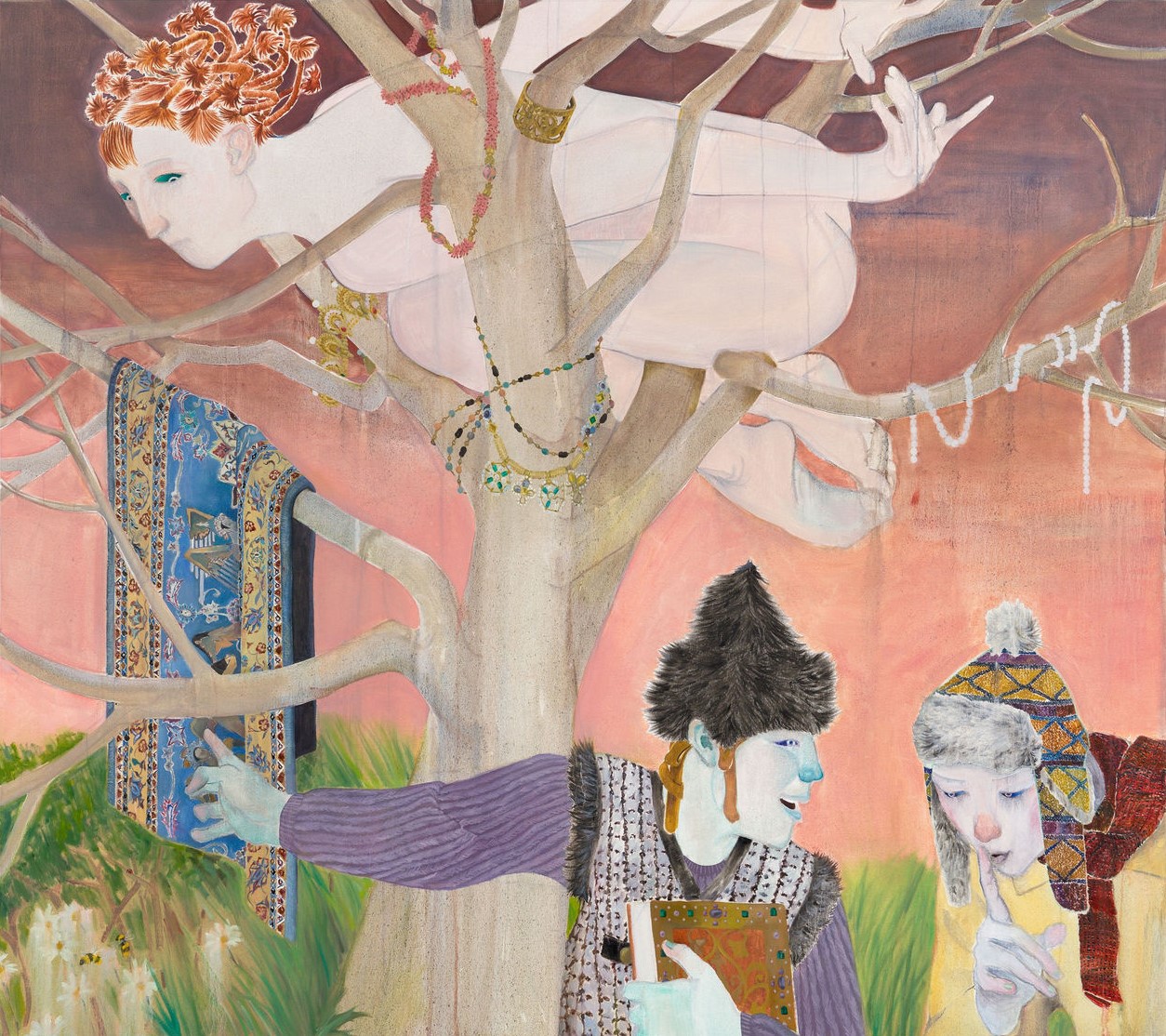
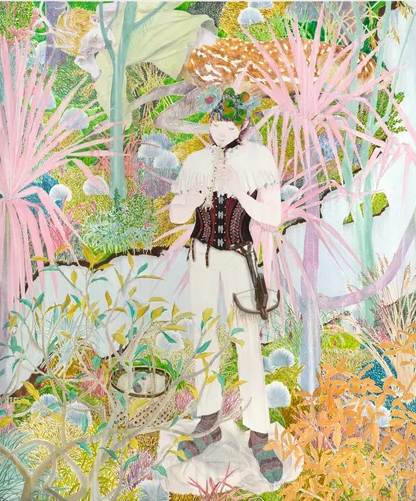
This ambiguity is particularly visible in Hunter’s Whistle from 2024. An androgynous figure plays a flute amid delicate vegetation, wearing a corset and carrying a crossbow. Nearby sits a human skull. Shilun has described his practice as a “sugar-coated bullet”: something that initially appears sweet and fragile before revealing something disturbing beneath the surface. It is a useful way to understand much of his work. Beauty attracts the viewer; unease makes them stay long enough to question what they are actually seeing.
An ancient technique for contemporary images
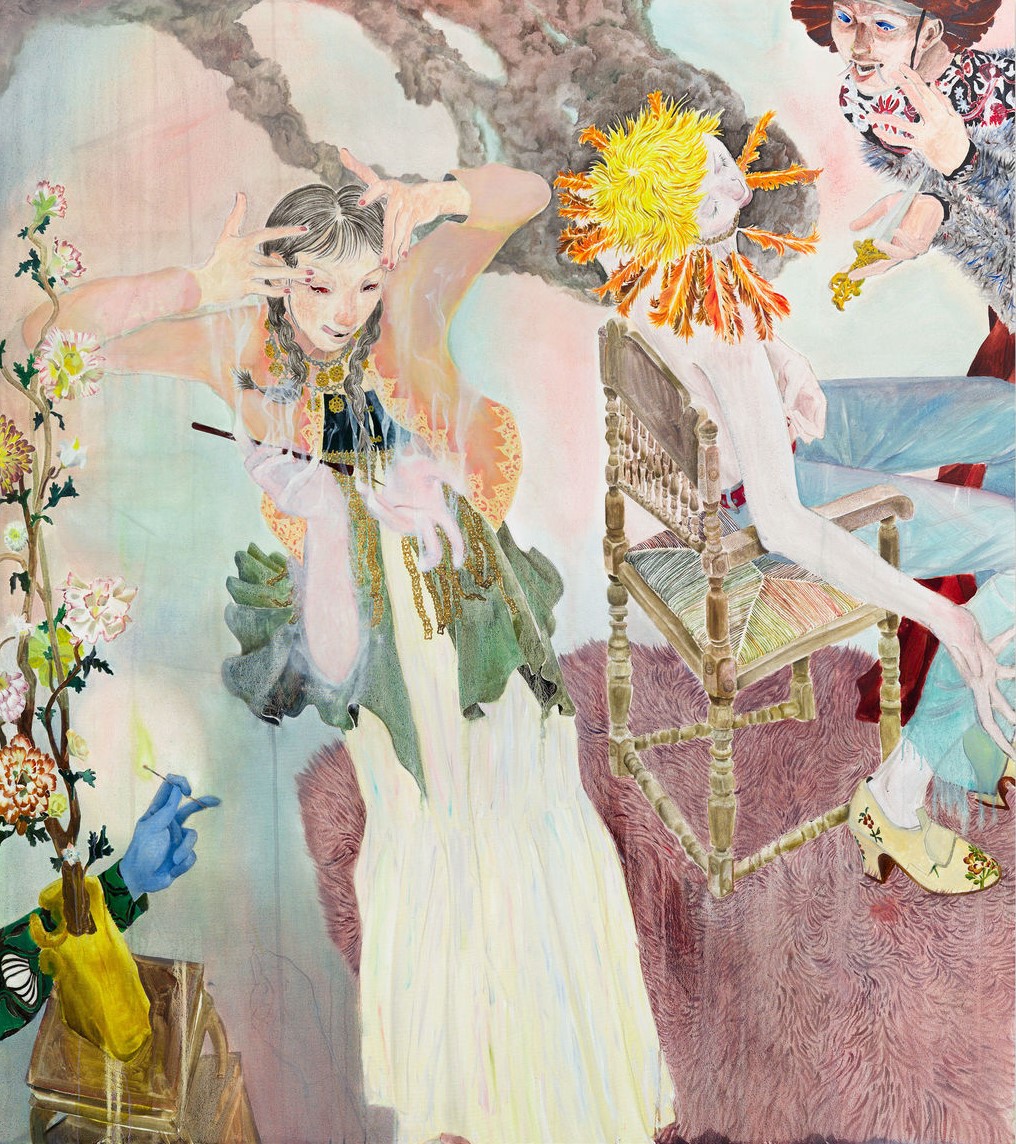
Behind the apparent freedom of these compositions lies an intensely controlled process. Raised in a family connected to painting and educated at the Guangzhou Academy of Fine Arts, the Slade School of Fine Art, and London’s Royal College of Art, Shilun looks to traditional Chinese techniques without simply reproducing their appearance. He dilutes oil paint into thin, translucent layers that recall the behaviour of ink and water-based pigments on paper. Across his large canvases, this technical lightness contrasts with densely populated scenes filled with details and simultaneous perspectives.
From private stories to collective history
In 2026, this practice reached a new scale. Following his first US museum solo exhibition at ICA Miami, Shilun presented Apocrypha 未入典 at Beijing’s Song Art Museum, his largest presentation to that point and his first museum solo show in Asia. The project began with the idea of apocrypha: stories excluded from official canons, whose authority may be uncertain but which can therefore generate alternative interpretations. It marks an important shift. The artist’s personal mythology begins to extend beyond individual identity, becoming a reflection on how history is constructed, what we choose to remember, and how many narratives inevitably remain outside the centre.
Why this painting belongs to our time?
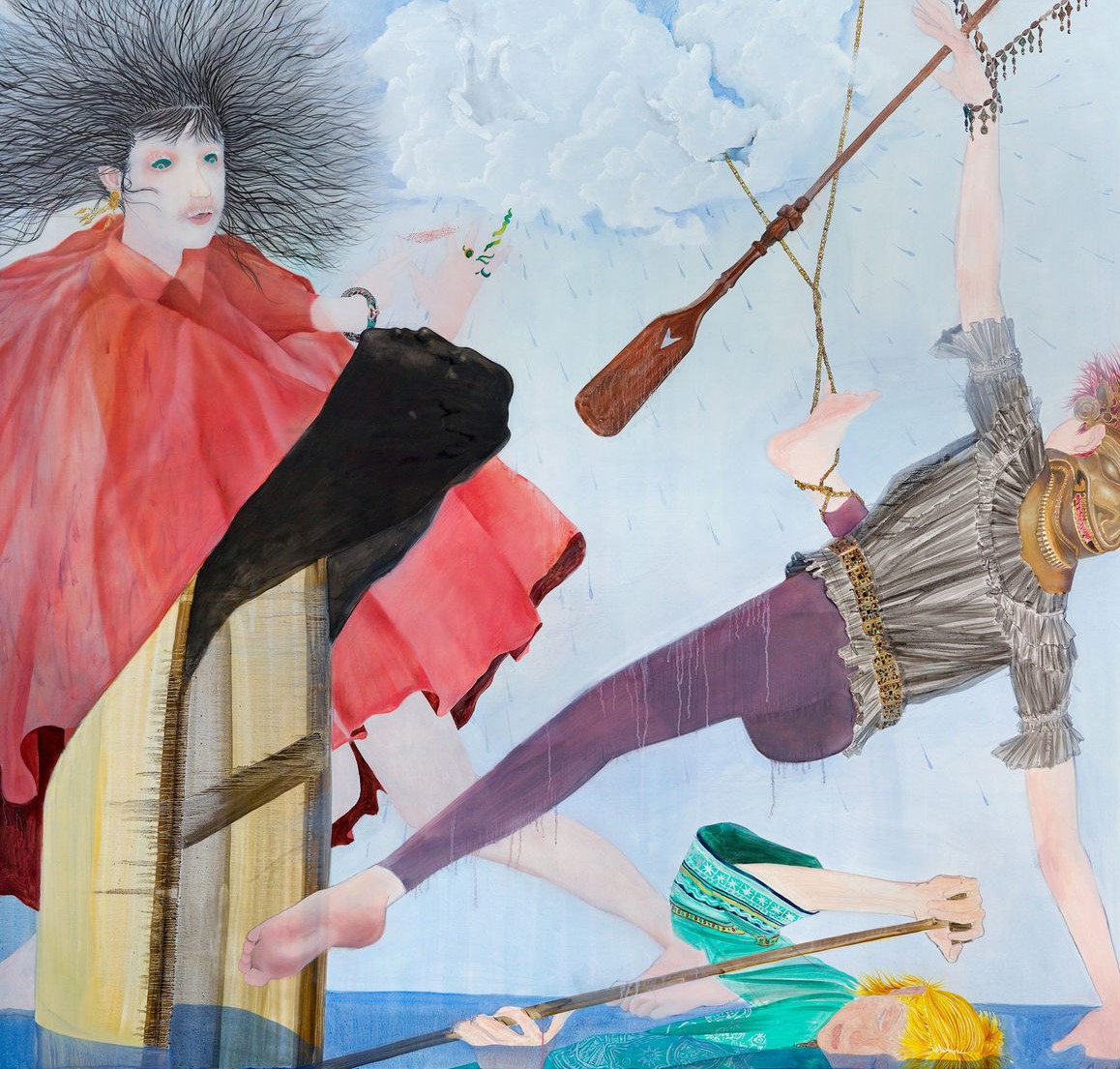
The significance of Ding Shilun’s practice does not simply lie in combining East and West. That would be too easy a reading. What matters is that no culture remains isolated within his work. Images arrive simultaneously from family memory, painting history, a film, the internet, or an object encountered in everyday life. This may be one of the defining visual conditions of the present: we live surrounded by references belonging to different places and periods, continuously creating new connections between them. Shilun does not attempt to impose definitive order on that chaos. He turns it into painting. Perhaps this is why his scenes, although entirely imagined, can feel strangely familiar.
Keep reading
Helen Beard: desire changes perspective
Saturated colours, tightly framed bodies, and images suspended between figuration and abstraction. Helen Beard uses painting to place female desire at the centre of the image, turning eroticism into a question of perspective, freedom, and representation.
Becky Tucker: what if the future looked like an archaeological artefact?
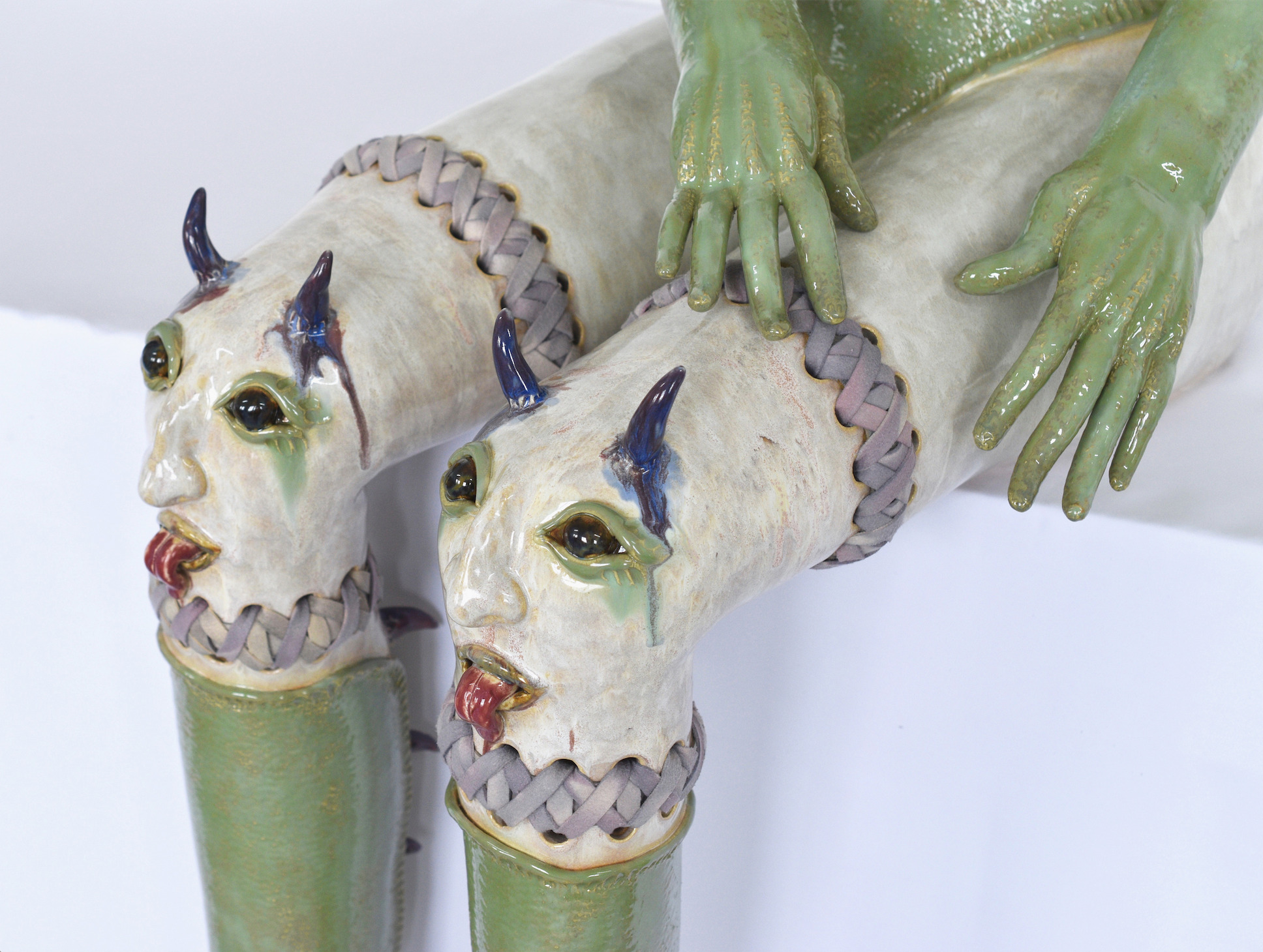
Pale creatures, impossible reptiles, armour, faces emerging from knees and ceramics that could be a hundred or three thousand years old. Becky Tucker creates objects deliberately difficult to place in time, bringing archaeology, mythology, horror and science fiction together. But if someone were to discover the remains of our civilisation one day, how much would they really understand about us?
Ben Crase: what happens when the cowboy no longer has to be tough?
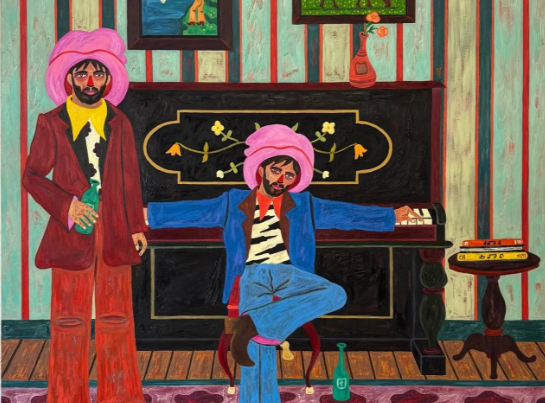
Pink hats, saloons, bears, big cats, chandeliers and men who look like brothers. Ben Crase takes one of the most enduring symbols of the American imagination—the cowboy—and moves him away from conquest, toughness and solitude to explore friendship, vulnerability and belonging. But how much can a myth change when we finally allow its men to be gentle?