
Bobbi Essers: friendship deserves a large painting
Embraces, hands, clothes, cars, and fragments of nights spent together. Bobbi Essers transforms analogue photographs of her friends into large-scale paintings in which faces often disappear. What remains at the centre is something art has depicted less often than we might think: the way friendship helps construct who we are.
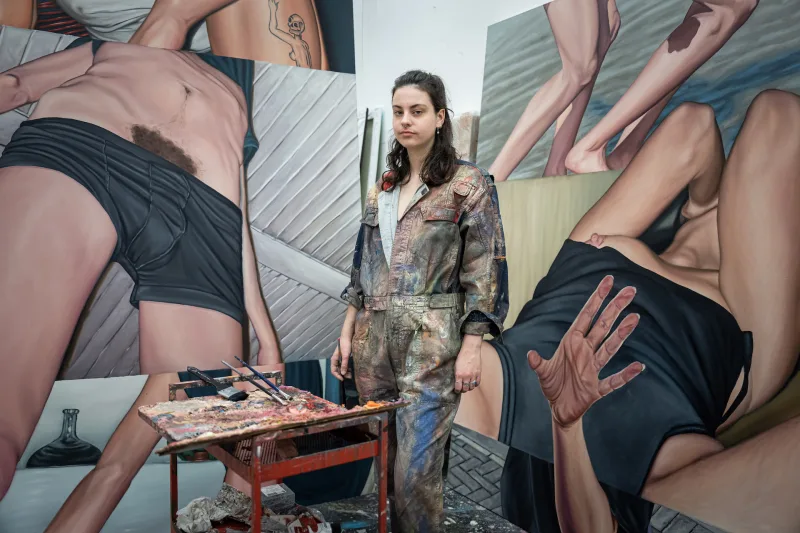
“My paintings seek to preserve these fleeting moments of intimacy, transforming them into spaces for reflection and emotional resonance.”
— Bobbi Essers, Mack Art Foundation, 2026
Recognising someone without seeing their face
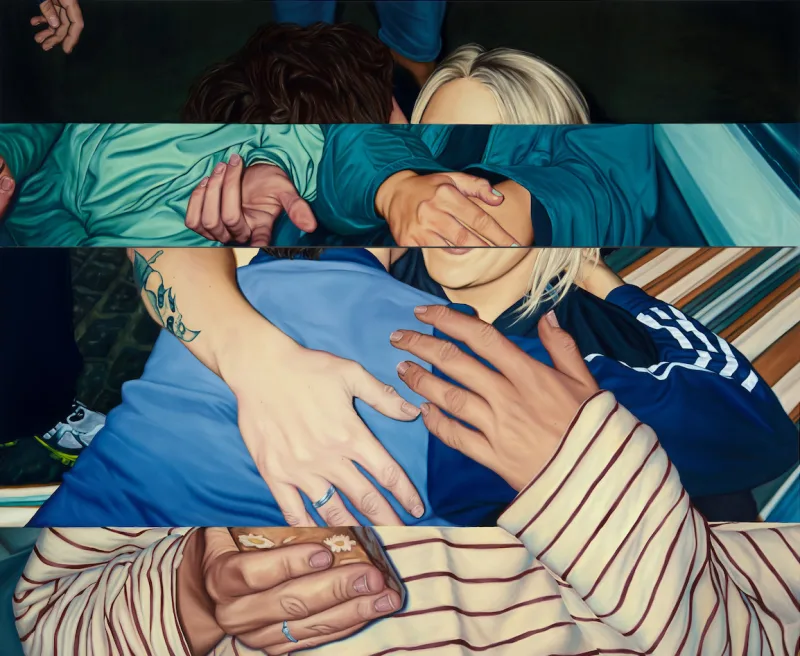
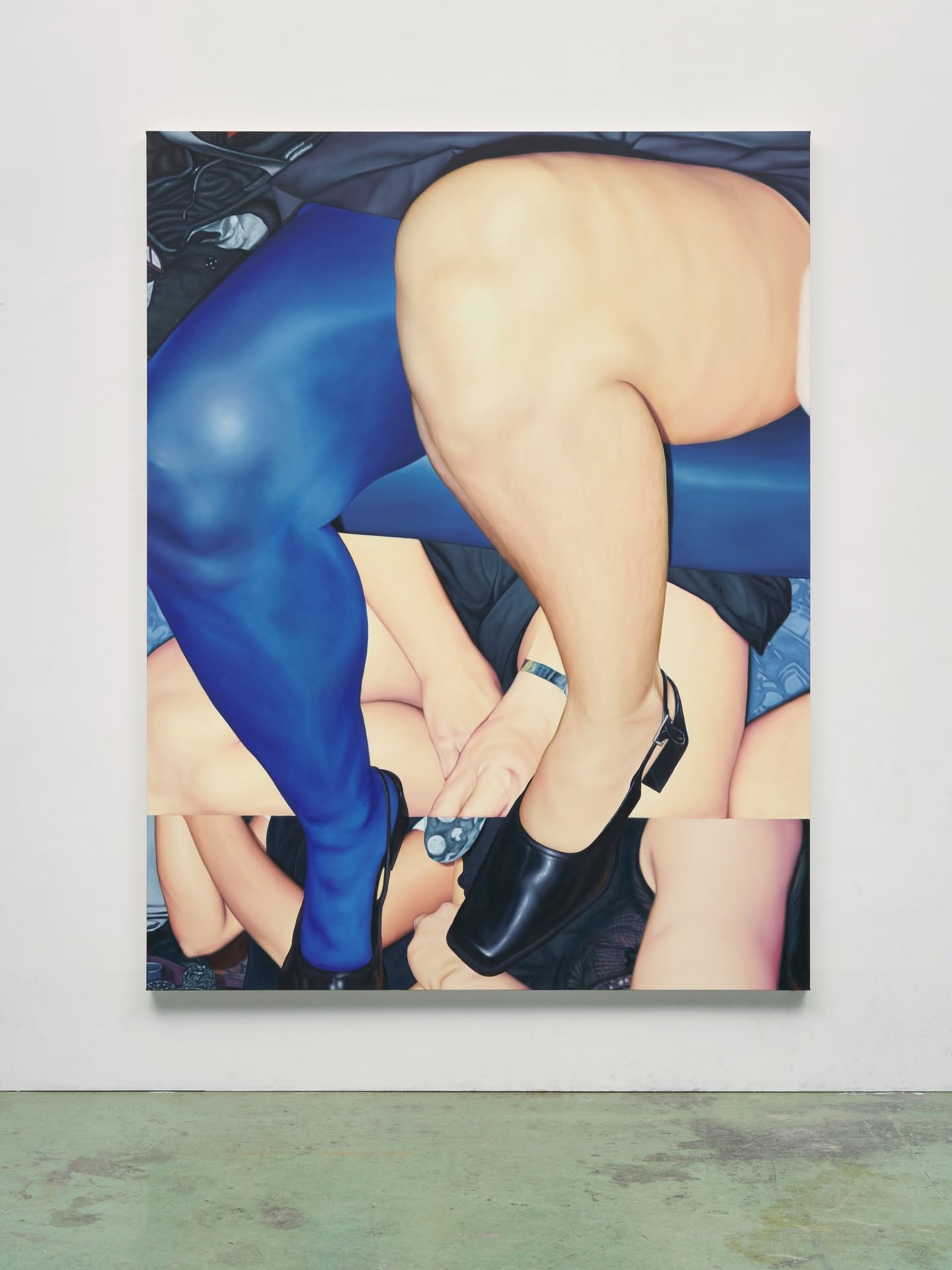
A hand resting on a leg. A blue tracksuit. An earring. Blonde hair entering the frame by only a few centimetres. In Bobbi Essers’s paintings, the face—the feature traditionally used to identify a person—is often absent. Yet the feeling of closeness remains. Born in Enschede in 2000, the Dutch artist creates large-scale canvases from experiences shared with her own circle of friends: journeys, bedrooms, parties, cars, waiting, and embraces become fragmented compositions in which gestures carry the relationships. Museum MORE describes these details—a shoulder, an earring, a lock of hair, an embrace—as fragments that resemble memories lingering after the night itself has ended.
What makes someone recognisable?
Removing faces might appear to make Essers’s figures anonymous. In practice, it almost does the opposite. The less official identity we are given, the more important become details that we notice only when we truly know someone: the way they cross their arms, a tattoo, a piece of clothing worn constantly, the posture they assume when they feel safe. Portraiture therefore stops being synonymous with facial resemblance and becomes something more physical and emotional. The jury of the Royal Award for Modern Painting, which Essers won in 2023, similarly highlighted her ability to capture intimacy between friends openly and affectionately, drawing viewers into her personal world.
How well do we have to know someone before we can recognise them without seeing their face? Perhaps this is one of the simplest and most effective ideas within her painting: intimacy has its own visual vocabulary.
Memory does not look like a photograph
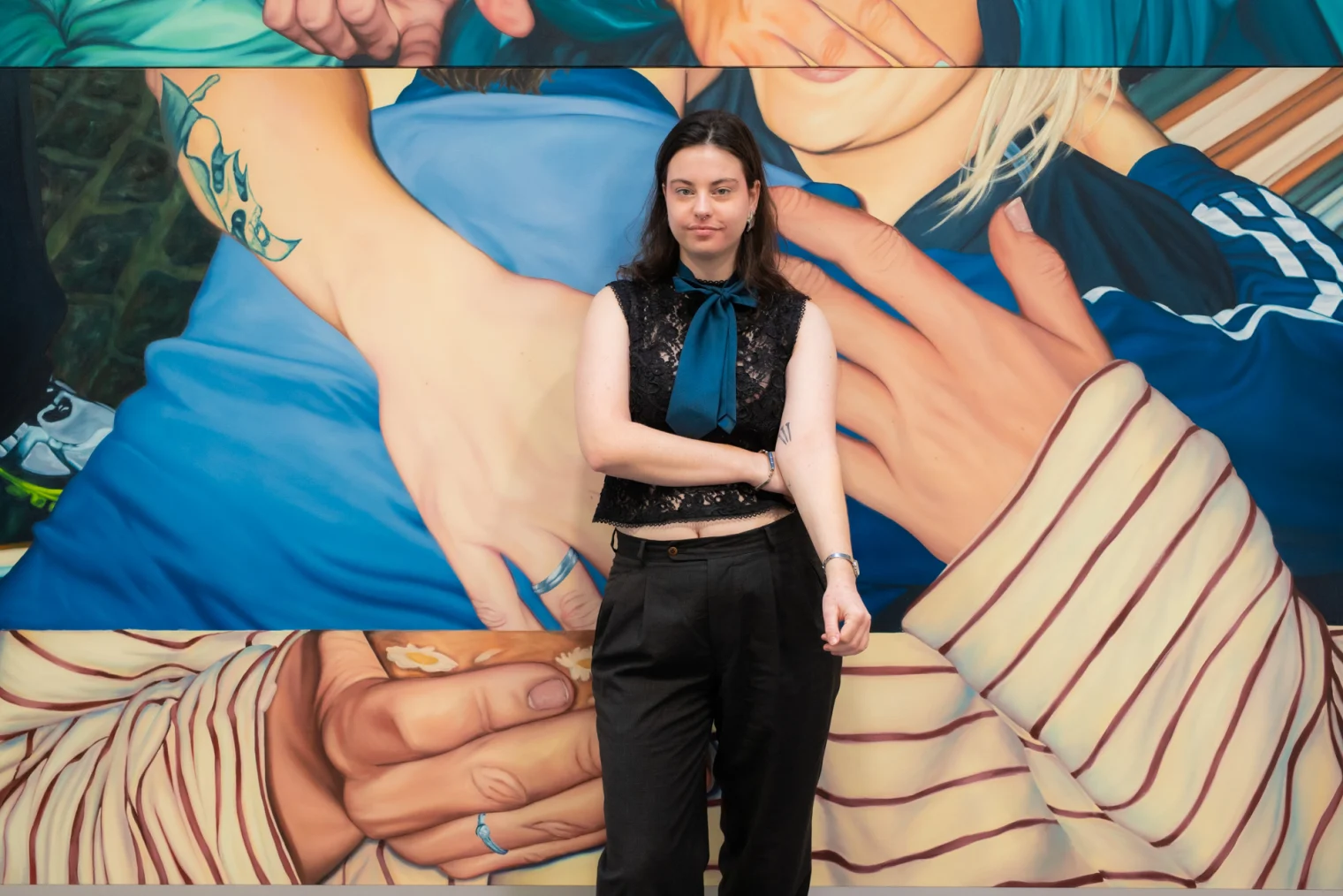
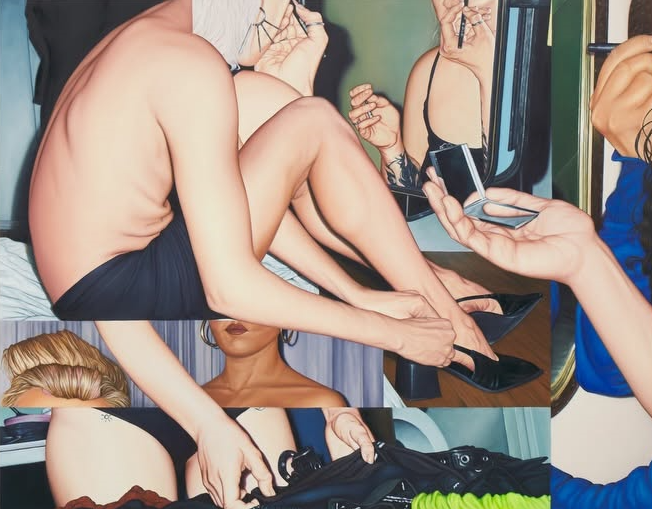
In her recent practice, Essers works from analogue photographs of her friends. The choice is not simply nostalgic. Analogue photography offers one shot and no immediate preview: it reduces control and preserves something accidental. The artist has explained that this helps keep her source images unforced and spontaneous. She then dismantles the photograph, combining different shots, changing proportions, interrupting bodies and interiors, and reconstructing time and space before translating the composition into paint.
The result resembles a document less than it resembles the actual operation of memory. We do not necessarily retrieve a complete frame. Details return instead: a hand on a steering wheel, someone sitting beside us, a colour, the feeling of a room. Fragmentation therefore does not destroy the memory. It may be precisely what makes it believable.
Putting friendship on a pedestal
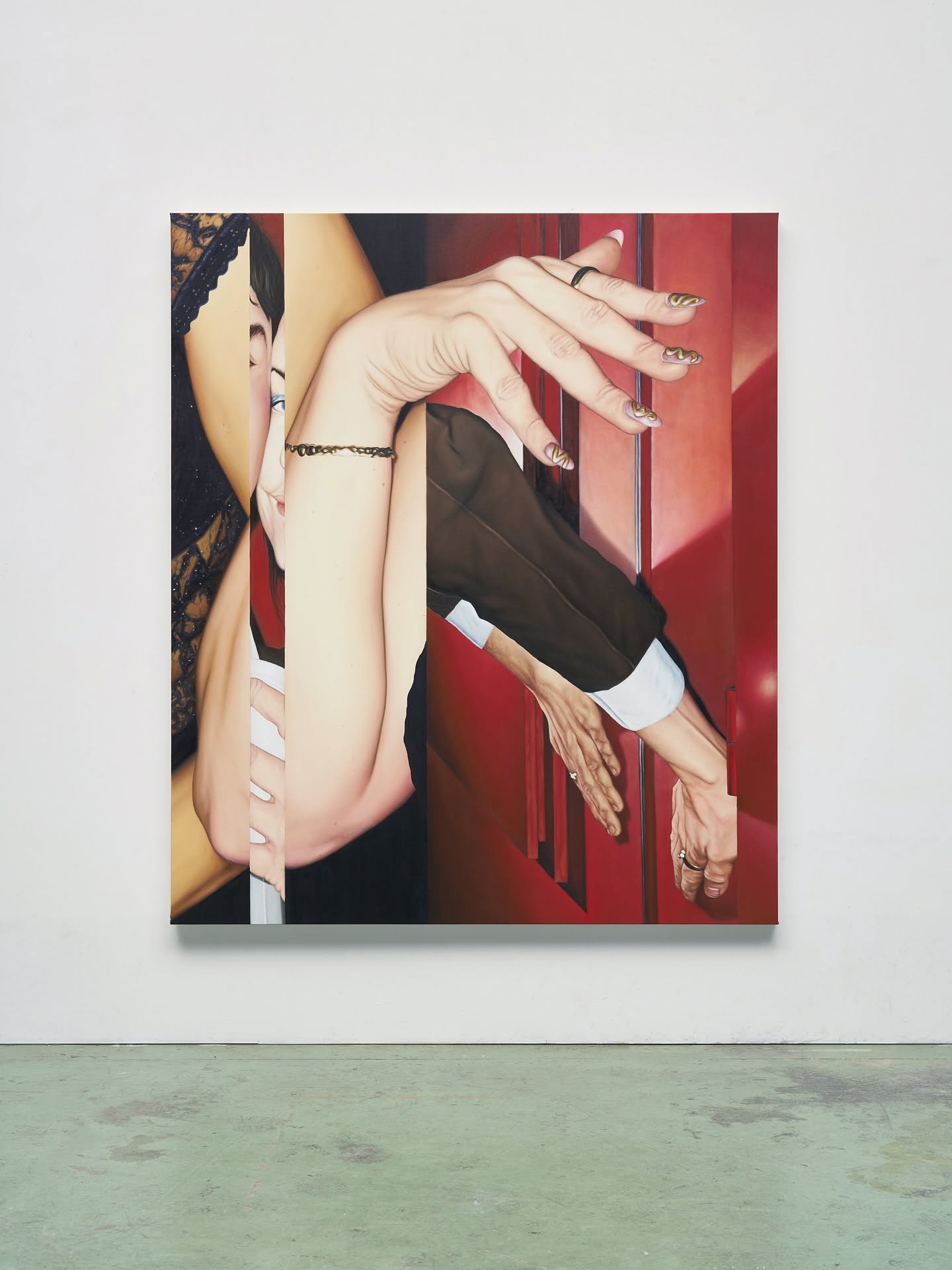
This is where scale becomes important. Essers does not preserve these moments in small private albums: she can transform them into paintings more than two metres high. A gesture that lasted only seconds acquires weeks of work and monumental presence. Western art history contains an enormous repertoire devoted to romantic love, family, marriage, motherhood, power, and individual identity. Friendship, despite being one of the relationships that most deeply shapes a life, rarely receives the same centrality. Essers effectively reverses that hierarchy: friends, rather than necessarily lovers or public figures, become worthy of the large format. In her 2026 artist statement, she explicitly describes placing her friendships “on a pedestal,” honouring the people around her by reliving and painting shared memories.
Why do we continue to treat friendship as a secondary relationship when it plays such a profound role in determining who we become?
A generation seen from within
Essers also speaks explicitly about Generation Z. Yet her paintings avoid turning that generation into a sociological category observed from outside. She belongs to the world she depicts. Queer, trans, non-binary, cisgender, gay, and straight identities coexist without necessarily being explained or turned into the didactic subject of the image. Museum MORE describes this openness through the idea of queer positivity: Essers often deliberately leaves gender and identity ambiguous, allowing her highly personal world to become more broadly recognisable.
The distinction matters. Difference does not appear as an exception requiring explanation, but as lived normality. The painting can speak about identity precisely because it does not have to continuously announce it.
Freezing a generation that refuses to stand still
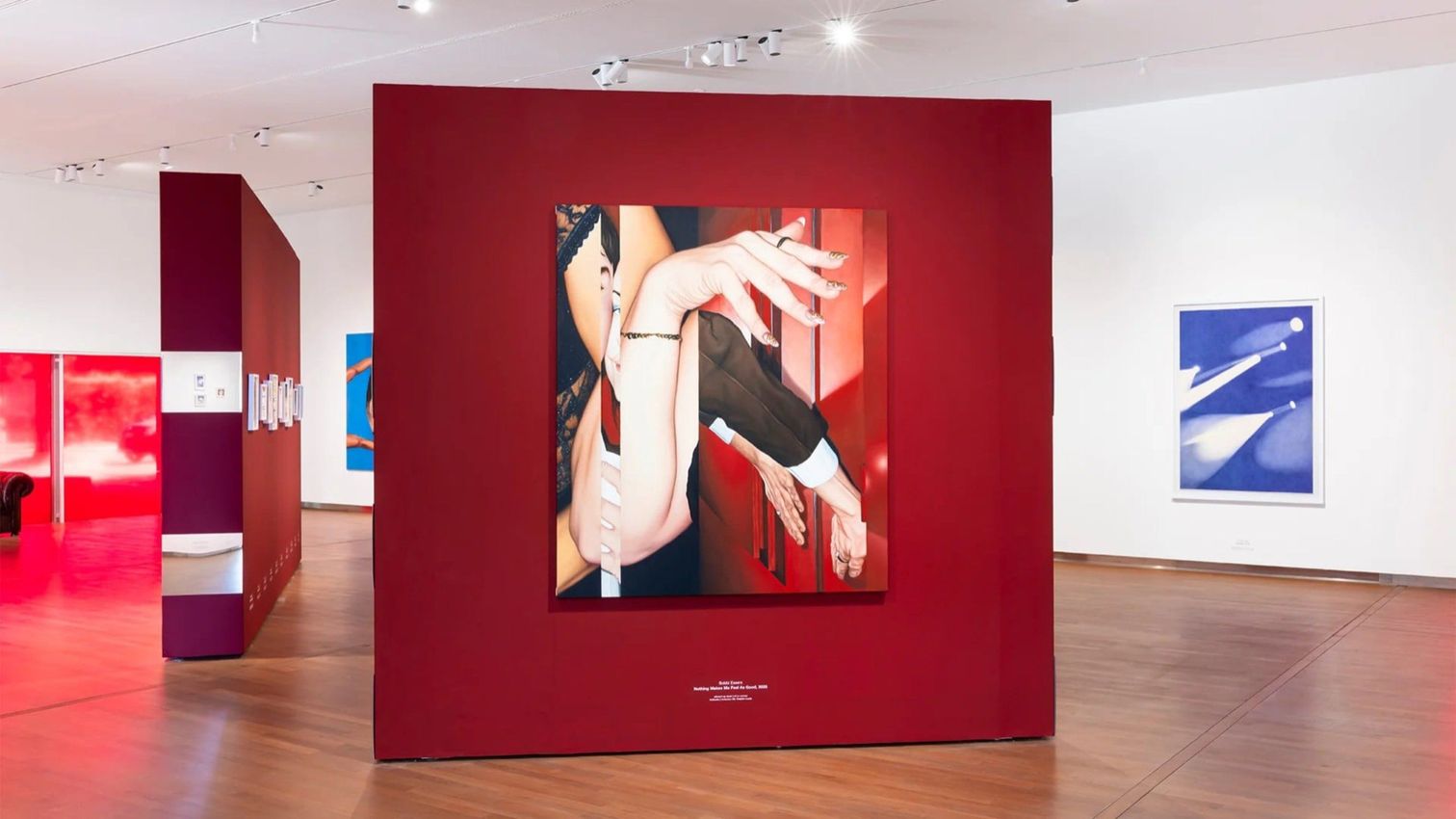
In 2026, Museum MORE paired Essers with Robin Wen in an exhibition exploring two different ways of representing a generation’s desire for freedom. On one side are Essers’s paintings based on analogue photographs of friends; on the other, Wen’s blue ballpoint drawings rooted in Free Party and rave culture. The museum identifies a common strategy: both isolate cinematic moments and construct open-ended images in which what is omitted matters as much as what remains visible. The exhibition runs in Gorssel from 14 May to 15 November 2026.
For Essers, this slowing down is particularly significant. We live within a culture that produces almost unlimited photographs of friendships, parties, and journeys, then consumes them with equal speed. She takes one of those fleeting images, fragments it, slowly repaints it, and brings it to museum scale. Painting therefore does not compete with photography in its ability to record a moment. It does something different: it decides which moment deserves not to disappear.
From a circle of friends to the city
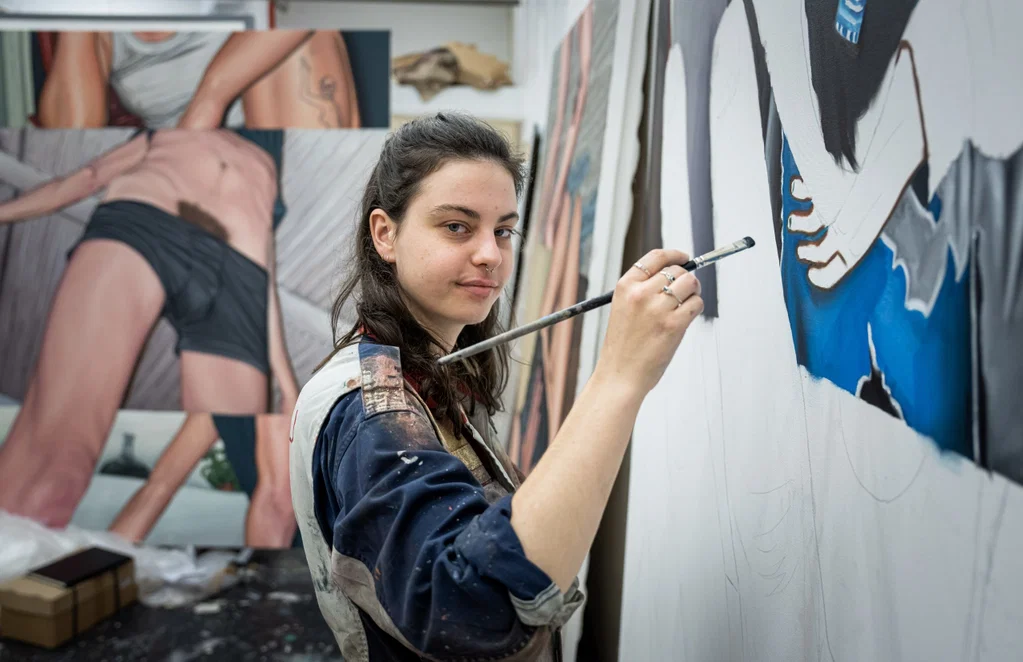
Her recent trajectory shows how quickly this practice is entering broader contexts. After graduating from HKU Utrecht in 2022, Essers received the Buning Brongers Prize that same year and the Royal Award for Modern Painting in 2023; in 2024 she completed her master’s degree at the Frank Mohr Institute. In 2024, Unit London presented her solo exhibition The World at Our Command. Between November 2025 and January 2026, her work appeared at Saatchi Gallery in Standing on the Shoulders of Giants II, developed with the Victoria and Albert Museum around the historic and continuing visibility of women artists. Between June and July 2026, Essers then worked in New York as a resident at the Mack Art Foundation. In a city shaped by millions of intersecting lives, she described becoming even more aware of the ways tenderness and belonging can emerge in unexpected places.
Perhaps a portrait does not need to show who you are
Bobbi Essers’s painting begins with an intensely specific universe: her friends, her memories, photographs taken while life is happening. Yet the more personal the work becomes, the less it seems to require us to know exactly who these people are. That is the paradox that makes the paintings compelling. By removing faces, Essers does not erase identity; she allows another kind of recognition to emerge. We understand that these bodies know one another. We see it in the way they touch, the space they allow each other, and the ease with which they can remain close. Perhaps friendship works in much the same way. It does not always possess the public rituals of romantic love or the formal structures of family. Much of its significance exists in moments that appear too small to enter history. A drive somewhere. A night that went on too long. A hand. A shoulder. Someone who stayed. If these are the moments that construct an essential part of who we become, why should they be too small for large-scale painting? Essers appears to have already chosen her answer: she enlarges them until they occupy the wall.
Keep reading
Helen Beard: desire changes perspective
Saturated colours, tightly framed bodies, and images suspended between figuration and abstraction. Helen Beard uses painting to place female desire at the centre of the image, turning eroticism into a question of perspective, freedom, and representation.
Becky Tucker: what if the future looked like an archaeological artefact?
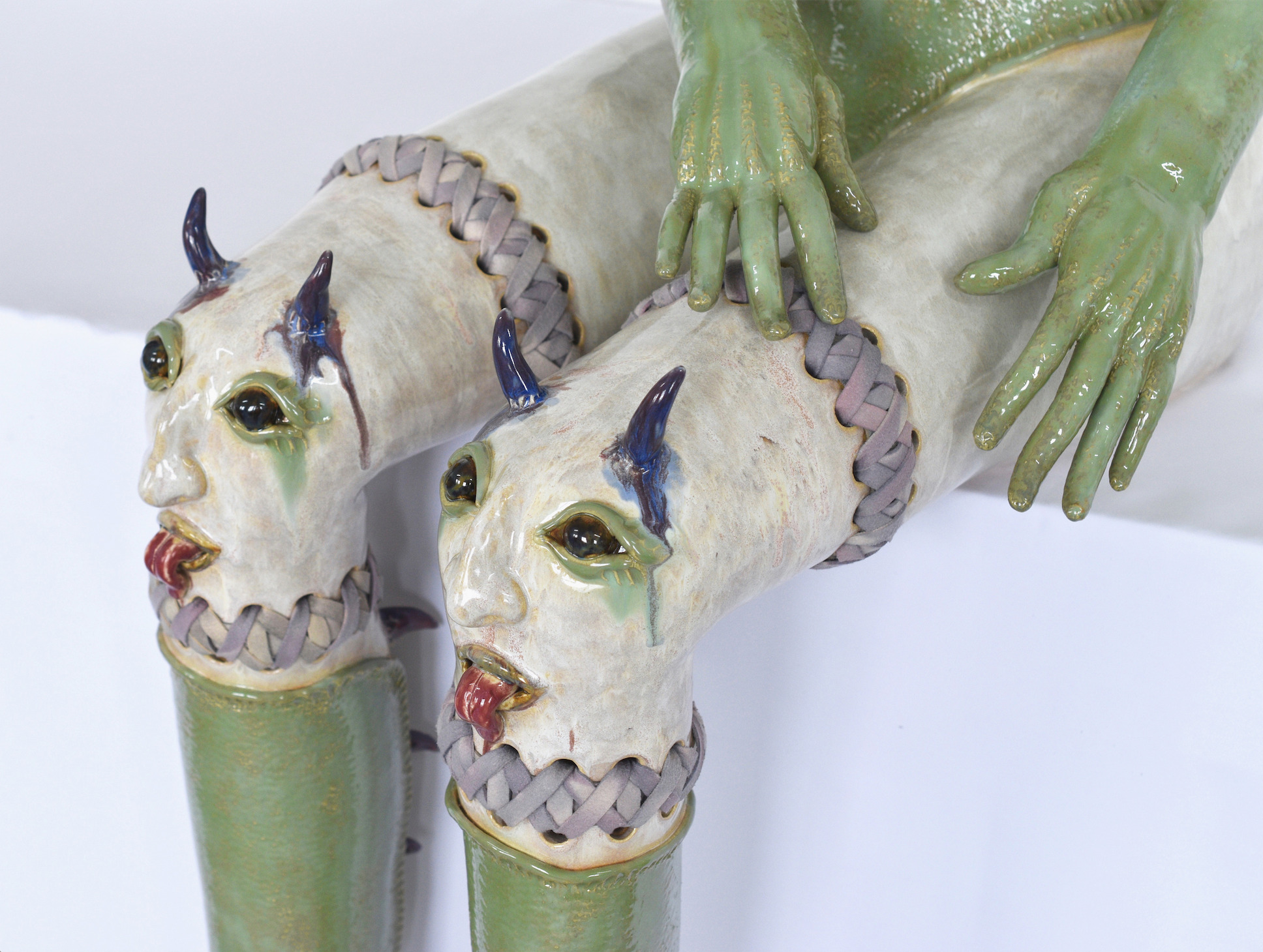
Pale creatures, impossible reptiles, armour, faces emerging from knees and ceramics that could be a hundred or three thousand years old. Becky Tucker creates objects deliberately difficult to place in time, bringing archaeology, mythology, horror and science fiction together. But if someone were to discover the remains of our civilisation one day, how much would they really understand about us?
Ben Crase: what happens when the cowboy no longer has to be tough?
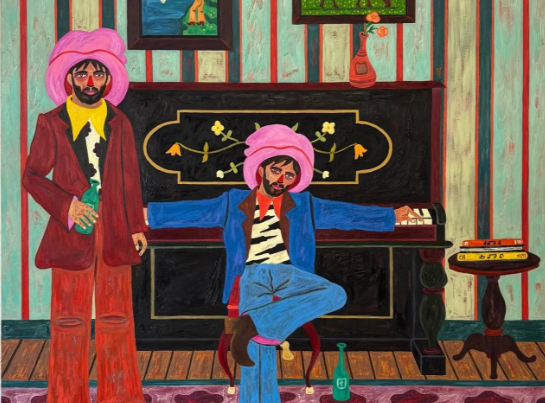
Pink hats, saloons, bears, big cats, chandeliers and men who look like brothers. Ben Crase takes one of the most enduring symbols of the American imagination—the cowboy—and moves him away from conquest, toughness and solitude to explore friendship, vulnerability and belonging. But how much can a myth change when we finally allow its men to be gentle?