
Régis Deparis: darte signed a retrospective between France and Puglia
Almost thirty works, more than forty years of painting and a story spanning France, Rome, Egypt and Salento. Darte brings Régis Deparis’s retrospective to Lecce, produced within Lecce Art Week and curated by Tancredi Hertzog-Guarini with Galerie T&L in Paris. Twelve years earlier, writing in La Règle du Jeu, Gilles Hertzog had called for a major retrospective of the artist and identified Lecce as one of the places where it should happen. The project turns that possibility into reality, bringing renewed attention to an original and difficult-to-classify figure in European painting of the second half of the twentieth century.
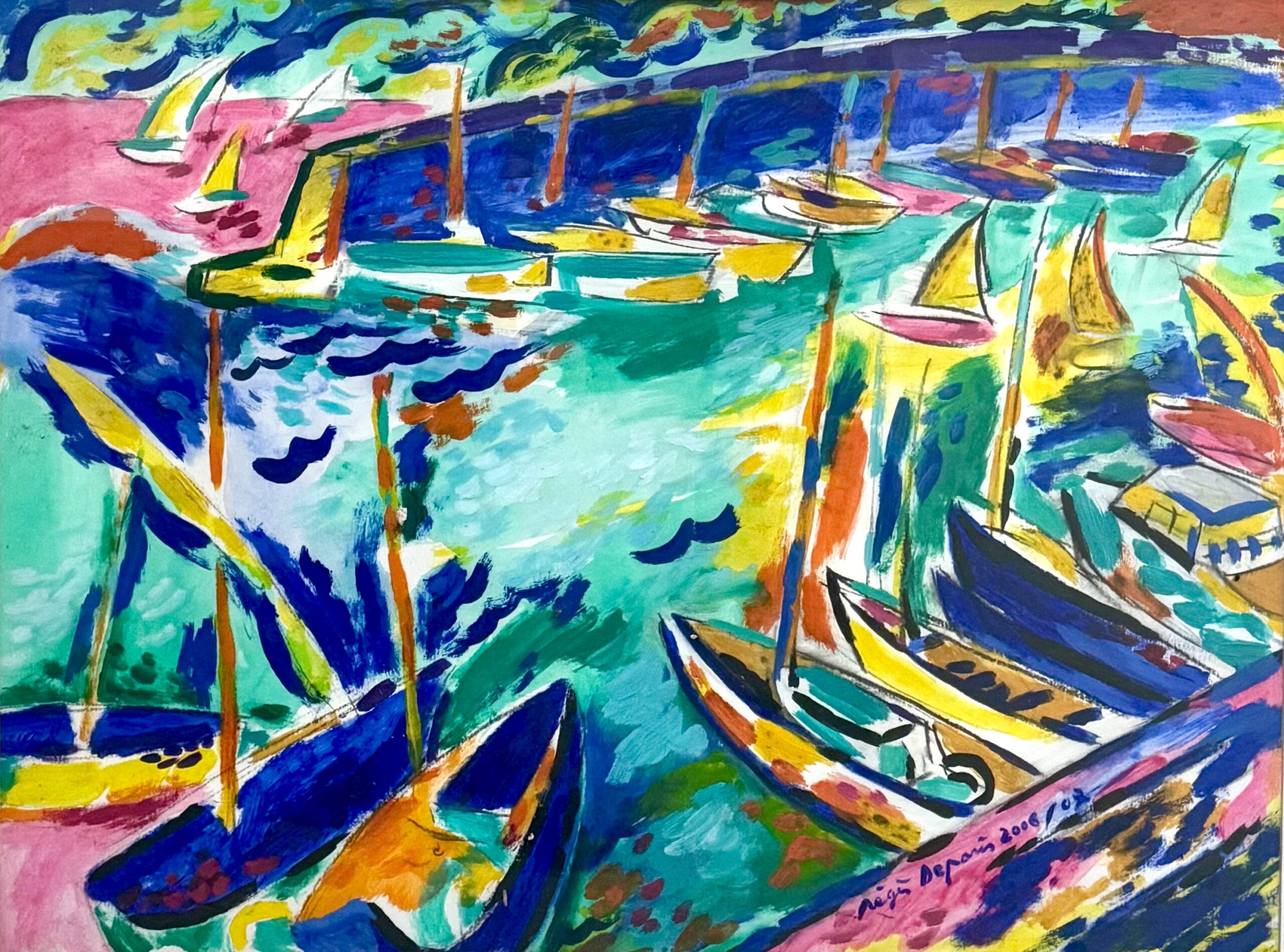
“For Régis Deparis, a friend and painter who sees the world around us with a panache I thought had disappeared.”
— Raymond Mason, dedication to Régis Deparis, July 1992 in La Règle du Jeu
In 2013, someone calls for a retrospective. Darte makes it happen in Lecce
In June 2013, only days after Régis Deparis died, Gilles Hertzog published an extended remembrance of the French painter in La Règle du Jeu. The text ends with a remarkably precise wish: the best tribute would be a major retrospective capable of encompassing the many dimensions of Deparis’s work, first in northern France and then, perhaps, in Lecce, which Hertzog describes as his final homeland. Twelve years later, that possibility takes form. From 20 to 30 June 2025, Darte produces Régis Deparis. A French Painter in Puglia in Lecce, bringing together almost thirty works from private collections in the Museo Diocesano, housed within Palazzo del Seminario. Presented as part of Lecce Art Week, the exhibition is curated by Tancredi Hertzog-Guarini with Galerie T&L in Paris and, according to the gallery’s documentation, constitutes the first tribute to Deparis by an Italian museum. This is where Darte’s role becomes decisive. Andrea Tapparini, founder of Darte and the figure leading Lecce Art Week, establishes the project and production framework through which Parisian research becomes an Italian museum exhibition. Darte connects Galerie T&L, the art-historical curatorship, lenders, an institutional venue and the wider system of a festival produced and promoted by the group. Contemporary coverage of the 2025 edition identifies Lecce Art Week as a project produced by Darte and directed by Tapparini, developed through a network of museums, foundations, curators and national and international partners. The distinction matters. The retrospective does not arrive in Lecce as a ready-made format. It emerges from the convergence of different forms of expertise. Galerie T&L contributes its knowledge of the artist and its research; Hertzog-Guarini constructs the curatorial reading; Darte makes the project public and tangible, coordinating its production, venue, relationships, exhibition structure and integration within the city. The result is not simply an exhibition about Deparis, but the reconstruction of an artistic history scattered across several places and several decades.
A European painter who refuses to fit into a single movement
Régis Deparis is born in northern France in 1948, studies at the École des Beaux-Arts in Lille and the École nationale supérieure des arts décoratifs in Paris, and then chooses Rome, where he lives for around ten years. In 1973 he meets Henri Cueco and becomes connected to the Jeune Peinture scene; from 1974 he exhibits in Paris, Milan and Genoa. His trajectory soon expands across a wider geography, from the Musée d’Art Moderne de la Ville de Paris and the Grand Palais to French institutions and exhibitions in Italy and abroad. Yet a list of places cannot explain Deparis. His position is compelling precisely because it resists a single genealogy. He remains committed to figuration during decades in which figuration is repeatedly declared obsolete, but he never turns that choice into a nostalgic return to traditional painting. History, objects, architecture, animals, landscapes and human figures enter images that can be ironic, theatrical, erudite and suddenly unsettling. Writing in La Règle du Jeu, Gilles Hertzog describes Deparis as an artist in whom painting and culture are inseparable and places him, in spirit and sensibility, alongside Pierre Klossowski, Raymond Mason and Enrico Baj. At his strongest, Hertzog argues, Deparis belongs on their level. Works held in public collections also reveal how established this trajectory already is. The Musée d’Art Moderne de Paris holds La commode, an oil on canvas dating from around 1975 and measuring 96 × 146 centimetres, in which an ordinary domestic object becomes the centre of an ambiguous figurative construction. Deparis’s name also appears in inventories and literature connected to collections including the Musée de Grenoble, the Fonds national d’art contemporain and FRAC Franche-Comté, as well as major reference works such as the Bénézit Dictionary of Artists. This is one reason why the retrospective developed by Darte does not take the form of a sentimental rediscovery. Deparis is not an artist without a history. He is an artist whose history exists in many fragments without always having been brought together into a single narrative. The exhibition exists precisely to bring those fragments back into proximity.
Rome and Egypt: painting inside history
Rome introduces a question into Deparis’s painting that never fully disappears: what remains of history once the power that produced it has vanished? Villas, gardens, architecture and ruins are not simply backgrounds. They become surfaces on which the present continues to encounter what came before it. In Francesco Ruggiero’s reading for the 2001 Palazzo Ruspoli retrospective, Deparis’s Rome is connected to the dissolution of immense power: the monument preserves grandeur, but also evidence of its collapse. Series such as Paysages italiens, Isola Bella and Villa Lante emerge from this relationship. In 1985, the research moves towards another monumental civilisation. Deparis receives the Villa Médicis hors les murs, a French programme that allows him to work in Egypt around Karnak and Luxor. In 1986, the Musée d’Art Moderne Lille Métropole presents Régis Deparis en abîmes, connected to the Descente aux tombeaux series. Archaeology, tombs, pharaonic architecture and the Egyptian landscape intensify a question already present in the Roman works: history is not illustrated but used as visual and psychological material. It is significant that Gilles Hertzog, writing about Deparis, emphasises precisely this ability to move from pharaonic temples to monumental plants, from ancient architecture to the human figure. Cultural heritage is not an archive that must be cited correctly in his work; it is something that can be displaced, reinvented and brought into the present. The Lecce retrospective makes this continuity visible. Rome, Egypt and Salento do not become three touristic chapters in the biography of a travelling painter. They are three places that materially alter the way Deparis uses space, memory and colour. Geography becomes painting.
Enrico Baj and The Divided Self: two artists inside the same work
In 1991, Deparis meets Enrico Baj. Their relationship does not remain a friendship between two painters: it develops into an experiment in shared authorship. In 1993 they present The Divided Self / Le Moi divisé at Galerie Barbier-Beltz in Paris, a body of approximately forty-five works created collaboratively and developed in response to R. D. Laing’s celebrated The Divided Self: An Existential Study in Sanity and Madness, originally published in 1960. The Paris exhibition runs from 6 May to 12 June and is accompanied by a 47-page catalogue containing thirty colour plates. Laing is not used simply as an intellectual reference. His study revolves around fractured identity, the distance between the self and the world, and the possibility that the self may not be experienced as a stable unity. Baj and Deparis transform this idea into a material problem of painting: what happens to the identity of an artwork when two artists intervene on the same surface? Baj brings a practice built on assemblage, grotesque distortion, the deformation of the figure and an ironic critique of structures of power. Deparis introduces his narrative repertoire, the weight of memory, his use of historical references and a figurative language capable of moving between elegance and unease. In The Divided Self, neither language is required to defeat the other. The work succeeds precisely because it remains divided: one image contains two decisions, two hands and two visual systems that remain recognisable. The project continues beyond Paris: in 1994, Baj & Deparis: The Divided Self reaches Tribeca Art Gallery in Milan. This matters because it demonstrates that the relationship with Baj is not a marginal anecdote in Deparis’s biography but a sufficiently developed investigation to produce an entire body of work, a catalogue and subsequent exhibition history. Within the retrospective produced by Darte, these works therefore have a precise function. Their inclusion repositions Deparis within a European network of exchange and challenges the convenient image of an isolated painter working far from the centres of art. Gilles Hertzog describes him as a brother in painting and spirit to Baj, Raymond Mason and Pierre Klossowski: an observation that conveys the intellectual network surrounding his work more effectively than many conventional classifications.
Puglia is not a backdrop. It changes the painting
During the 1990s, Salento progressively enters Deparis’s life and painting. He spends increasing amounts of time in the region, works through its landscape and architecture, and eventually chooses Lecce as a place to settle. The transformation is not merely geographical. The darker tonalities of earlier cycles give way to more open colour, Mediterranean vegetation, gardens, palm trees and a quality of light that radically alters the atmosphere of the paintings. Galerie T&L associates this period with a neo-Fauvist sensibility, while Gilles Hertzog compares Deparis’s chromatic joy to that of Raoul Dufy. Hertzog emphasises reds, greens and yellows, seas, gardens and monumental plants, yet his reading never reduces the work to a celebration of the Mediterranean. Colour becomes the means through which Deparis transforms the world he observes. Puglia is not recorded; it is reinvented. This is why Salento belongs fully to the artist’s research rather than simply to his biography. In 2006, Deparis settles in Lecce and develops one of the most emblematic projects to emerge from this relationship: the approximately thirty-square-metre painted ceiling at Palazzo Palmieri, known as Histoire d’une famille, histoire du Salento – Hommage à Murat. Painting physically enters the historical architecture of the city and uses local episodes, memories and figures as material for a monumental composition. Darte’s decision to build the retrospective in Lecce therefore carries a significance far beyond territorial convenience. Deparis returns to the place that transforms his painting and where he, in turn, leaves tangible traces. It is no coincidence that in 2013 Gilles Hertzog identifies Lecce as one of the natural locations for a future major retrospective. When that project takes shape in 2025, the city does not function as a backdrop: it becomes one of the sources of the work the exhibition is attempting to understand.
Almost thirty works, Paris and Lecce: what it takes to build a retrospective
A retrospective only appears simple when all the work required to create it functions properly. The public enters a room and encounters almost thirty works; before that moment come research, selection, loans, relationships with collectors, transport, assessment of the venue, exhibition design, curatorial coordination, production of materials, communication and dialogue with the hosting institution. In the case of Régis Deparis, the complexity increases because the exhibition must hold together more than forty years of research and works belonging to profoundly different periods. Galerie T&L itself presents the exhibition as a journey built through almost thirty works drawn from private collections. It is within this architecture that Darte’s expertise becomes part of the exhibition itself. Production does not mean simply providing a space; it means creating the conditions through which Galerie T&L’s knowledge and Tancredi Hertzog-Guarini’s curatorial reading can become a coherent museum project in Lecce. Darte connects Paris and Puglia, research and production, lenders and institution, the individual exhibition and the wider structure of Lecce Art Week. Andrea Tapparini’s role operates precisely at this level. As Darte’s founder and the figure leading the festival, Tapparini defines the framework in which the retrospective enters the programme, supports its production structure and positions it within a broader vision of the city as a platform capable of hosting contemporary projects and international relationships. Lecce Art Week 2025 is publicly presented as a festival produced and promoted by Tapparini’s Gruppo Darte, with institutional patronage and a network of partners including museums, foundations, galleries and curatorial organisations. The collaboration with Galerie T&L is therefore complementary rather than incidental. The gallery follows Deparis’s work, develops research around it and brings to the project an art-historical knowledge accumulated over time; Darte provides the ability to translate that research into a complex production, place it within a museum setting and turn it into a public experience. The project’s prestige emerges precisely from this intelligent division of roles: not from overlapping expertise, but from making different specialisations work together. This is also where the retrospective acquires perhaps its strongest meaning. In 2013, La Règle du Jeu argues that Deparis has not received recognition commensurate with the quality of his work and explicitly calls for a major retrospective, identifying Lecce as one of the places where his story should become visible again. In 2025, Darte, together with Tancredi Hertzog-Guarini and Galerie T&L, creates exactly one of the conditions necessary for that to happen. Almost thirty works can therefore be seen not as independent fragments but as parts of a trajectory connecting Lille, Paris, Rome, Luxor, Enrico Baj and Salento. The retrospective does not attempt to close the discussion around Régis Deparis once and for all. It does something more useful: it reopens it. For Darte, this is also a statement about what cultural production means. Curating and producing a project does not simply mean displaying works; it means recognising a story that deserves to circulate again, finding the expertise required to interpret it, building the relationships necessary to make it possible and identifying the place where it can acquire new meaning. In the case of Régis Deparis, that place is Lecce.
Keep reading
Gil Zablodowsky: dove il suono diventa geometria
Per IMAGO al MUST di Lecce, Gil Zablodowsky porta l’astrazione digitale in dialogo con l’architettura, il suono e lo spazio fisico. In questa conversazione con DARTE, l’artista riflette sulla geometria come linguaggio visivo, sulla traduzione delle frequenze acustiche in immagini, sulla tensione tra precisione tecnologica e presenza umana e su ciò che accade quando l’arte digitale abbandona lo schermo per entrare nello spazio reale.
AI isn’t the problem. It’s showing us how predictable we are.
AI isn’t just learning how to make images. It’s learning how easily it can imitate what we call style.
Art is no longer competing only with art
An artwork now has to survive in the same world as fashion campaigns, music videos, memes, cinema, design and images generated in seconds.